
Your excavator just died in the middle of a job site. The foreman’s yelling. The client’s watching. And that grinding noise from the pump bay? Yeah, that’s not good.
First thought: Damn, how much is this gonna set me back?
I’ve been asked this question probably a thousand times over the years. And honestly? I can’t give you a straight number without knowing what you’re dealing with. A beat-up gear pump on a skid steer might cost less than a nice dinner for two. A shot Rexroth piston pump on a 350-ton excavator? That’s a used car.
Let me walk you through what actually drives hydraulic pump repair costs—and where most people get blindsided.
Not all pumps are created equal. That’s not marketing speak. It’s just physics.
A gear pump has maybe 20 moving parts. Simple. Cheap to make. Cheap to fix. A variable displacement axial piston pump? We’re talking precision-machined components held to tolerances tighter than your hair’s width. Nine pistons dancing in a rotating barrel at 3,000 PSI. When one of those goes bad, you’re not just swapping a seal.
Here’s what the market looks like right now:
| Pump Type | New Unit | Rebuild | What It’s Used For |
| External Gear Pump | $200–$2,500 | $150–$800 | Conveyors, ag equipment, low-pressure stuff |
| Internal Gear Pump | $400–$3,500 | $200–$1,200 | Machine tools, smoother flow needs |
| Fixed Vane Pump | $500–$4,000 | $300–$1,800 | Industrial hydraulics, mid-range applications |
| Variable Vane Pump | $800–$6,000 | $400–$2,500 | When you need flow control without servo |
| Axial Piston Pump | $1,500–$15,000+ | $800–$7,500 | Excavators, presses, anything heavy |
| Radial Piston Pump | $3,000–$25,000+ | $2,000–$12,000 | Ultra-high pressure, marine winches |
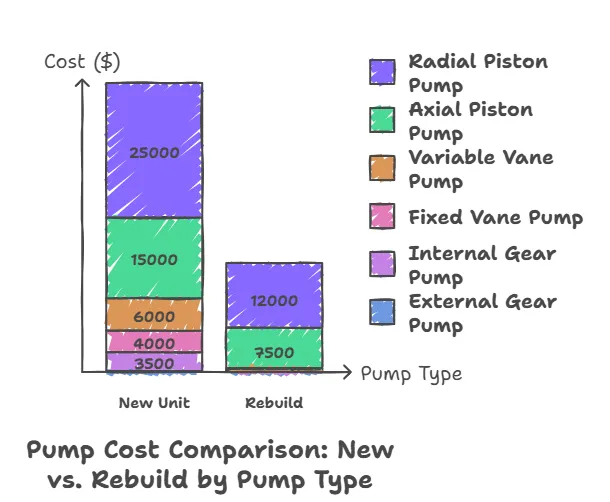
The price range for plunger pumps is the widest due to differences in displacement—the price of a 45cc pump can be more than three times less than that of a 180cc pump.
That $15,000 ceiling on piston pumps? I’ve seen jobs go past that. A Liebherr main pump for a mining excavator hit $28,000 last year. No typo.
Think of pump displacement like engine size in a truck. A 2-liter economy car and a 6-liter diesel don’t cost the same to rebuild. Same logic here.
The relationship isn’t linear, though. Going from a 45cc to a 90cc pump doesn’t double the price—it might triple it. Why? Bigger pistons need beefier bearings. Larger housings need more machining time. The swashplate assembly alone on a 180cc pump weighs more than some complete small pumps.
Rough brackets:
To put that in perspective: a 100 GPM pump moves about 6 bathtubs of oil per minute. That’s a lot of fluid being pressurized to 4,000+ PSI.
Alright, let’s talk about the elephant in the room.
A Rexroth A10VSO45 costs around $2,800–$3,500 from an authorized dealer. I can get you a Chinese-made pump with identical mounting dimensions and similar specs for $800–$1,200.
So what’s the difference? Is the German pump three times better?
Not exactly. But it’s not just about the sticker, either.
Premium tier (Bosch Rexroth, Parker, Eaton, Danfoss): These guys have been at it for decades. Their metallurgy is consistent. Their QC catches problems before they ship. When something goes wrong, you can actually get someone on the phone who knows what they’re talking about. Expected life: 8,000–12,000 hours under normal conditions.
Mid-tier (Kawasaki, Nachi, Yuken): Solid Japanese engineering. Maybe 15–30% cheaper than the Europeans. Fewer global service points, but quality you can count on. We’ve run Kawasaki pumps past 10,000 hours without issues.
Budget tier: This is where it gets complicated.
Not all Chinese manufacturers are the same. There’s a massive difference between a fly-by-night shop and an established facility with proper heat treatment and testing equipment. I’ve seen budget pumps fail at 800 hours. I’ve also seen them run 5,000+ hours without a hiccup.
Take our own operation as an example. Every pump that leaves Pozoom goes through a full-load bench test—not a quick spin, actual operating pressure for hours until we’re satisfied it’s right. We run metallurgical analysis on each batch of castings because that’s exactly where most budget manufacturers cut corners. One of our customers has been running a K3V replacement in his Kobelco excavator for over 7,000 hours now. Still going strong. That’s not a brochure number—it’s sitting in our service tracking system.
The difference between a serious manufacturer and the no-name stuff isn’t just the price tag. It’s whether someone actually verified the heat treatment specs, whether tolerances were held during machining, whether anyone picks up the phone when something goes wrong three months later.
The key is knowing who you’re buying from. Ask for metallurgical reports. Ask for test data. If they can’t provide it, walk away.
Here’s where I see people get caught off guard every single time.
The pump costs $3,000. Great. Budget set. Then the invoice comes in at $5,500 and suddenly everyone’s upset.
What happened? Labor. And it’s not padding—it’s just reality.
Swapping a pump on a skid steer sitting in a clean shop bay? Two hours, maybe three. I can have my guys do that before lunch.
Pulling the main pump on a Cat 349 excavator that’s been sitting in mud for six months? Different story entirely. You’re dealing with:
That 12-hour job I quoted? It turned into 18 because one mounting bolt snapped. Then we had to extract it, re-tap the hole, and still make sure the alignment was dead-on. That’s not incompetence. That’s fieldwork.
| Equipment | Labor Hours | What Drives the Time |
| Small forklift | 2–4 hrs | Easy access, standard setup |
| Skid steer | 3–5 hrs | Tight quarters but manageable |
| Standard excavator | 6–12 hrs | Main pump buried, lots of hoses |
| Large excavator (40+ ton) | 10–20 hrs | Everything’s heavy, often outdoor work |
| Injection molding machine | 4–8 hrs | Clean environment but precision alignment |
| Hydraulic press | 8–16 hrs | Multiple pumps, complex piping |
| Marine/offshore | 16–40+ hrs | Access issues, certification requirements |
Shop rates run $85–$150/hour for standard work. Specialized stuff—marine, aerospace, cleanroom—can push $200+.
Here’s my rule of thumb: take the pump price, add 40–60% for a typical excavator job, more for anything complicated. That gets you in the ballpark.
This is the question I get at least once a week. And honestly, there’s no universal answer. But I can tell you how I think through it.
Rebuild makes sense when:
Hydraulic pump repair is the smarter choice if the damage is limited. Worn seals, tired bearings, minor scoring on wear plates—that’s all rebuildable. If the guts are still good, spending $1,500 to save a $4,000 pump is smart math.
The pump is premium. A Rexroth or Parker that’s only halfway through its life? Absolutely worth rebuilding. The housing alone on those things is worth more than some complete budget pumps.
Time is on your side. A proper rebuild takes 3–5 days if parts are in stock. If you can wait, you save money.
Replace it when:
The housing is cracked. Game over. You can’t weld cast iron pump housings and expect them to hold 4,000 PSI.
The shaft is bent. I’ve seen guys try to straighten pump shafts. Don’t. The tolerances are too tight. It’ll just fail again in 500 hours.
It’s already been rebuilt once. Second rebuilds rarely deliver. The tolerances stack up, the fits get loose.
Contamination wrecked everything inside. When debris scores the barrel, pistons, valve plate, and swashplate, you’re basically buying a new pump anyway—just in pieces.
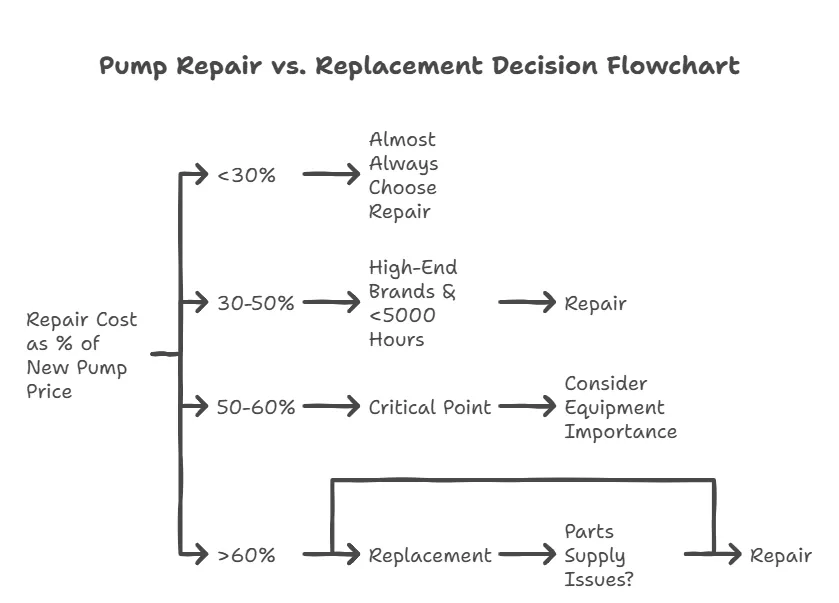
This ratio is based on statistics from hundreds of cases handled by our team. It’s not textbook data, but real-world experience.
The Fluid Power Journal published a study showing properly rebuilt pumps deliver 80–90% of original service life. That tracks with what we see in the shop—assuming the rebuild is done right with OEM-spec parts.
Theory is nice. Numbers are better. Here’s what you’ll actually pay for common models as of early 2025:
Axial Piston Pumps (the workhorses)
| Model | Size | New Price | Rebuild |
| Rexroth A10VSO45 | 45cc | $2,800–$3,500 | $1,200–$1,800 |
| Rexroth A10VSO100 | 100cc | $5,500–$7,000 | $2,500–$3,500 |
| Parker PV046 | 46cc | $2,400–$3,200 | $1,000–$1,600 |
| Parker PV092 | 92cc | $4,800–$6,200 | $2,200–$3,000 |
| Eaton Vickers PVB29 | 29cc | $1,800–$2,400 | $800–$1,200 |
| Kawasaki K3V112 | 112cc | $4,500–$6,000 | $2,000–$3,000 |
| Kawasaki K3V180 | 180cc | $7,500–$9,500 | $3,500–$5,000 |
Gear Pumps
| Model | Flow | New | Rebuild |
| Parker PGP500 series | 5–50 GPM | $350–$1,800 | $150–$600 |
| Rexroth AZPF series | 4–45 GPM | $400–$2,200 | $200–$800 |
| Commercial P50 | 10–60 GPM | $300–$1,500 | $120–$500 |
Vane Pumps
| Model | Flow | New | Rebuild |
| Eaton Vickers V/VQ | 5–60 GPM | $600–$4,500 | $300–$1,800 |
| Denison T6/T7 | 10–100 GPM | $800–$5,500 | $400–$2,200 |
| Yuken PV2R | 5–50 GPM | $450–$2,800 | $200–$1,000 |
These prices move. Supply chain hiccups, currency swings, even seasonal demand can shift things 10–15% either way. The A10VSO100 jumped about 8% in late 2024 when a key casting supplier had issues. That’s settled now, but it shows how volatile this market can be.
If you’re sourcing pumps and want options beyond the usual suspects, Pozoom’s pump catalog has been our go-to for aftermarket units that actually perform. Not cheap garbage—actual tested pumps with real specs.
Understanding total hydraulic pump repair cost means looking beyond the pump itself. You got your pump quote. You got your labor quote. You’re ready.
Then someone mentions you need new hoses. And the coupling looks worn. And while we’re in there, the charge pump is making noise…
Sound familiar?
Stuff you’ll probably need:
Stuff you should do while you’re in there:
I had a customer last month who balked at a $400 flush. Put the new pump in with old oil. Came back six weeks later with the same symptoms. Debris that should’ve been flushed out destroyed the new valve plate. Another $2,200.
That $400 flush is looking pretty cheap now.
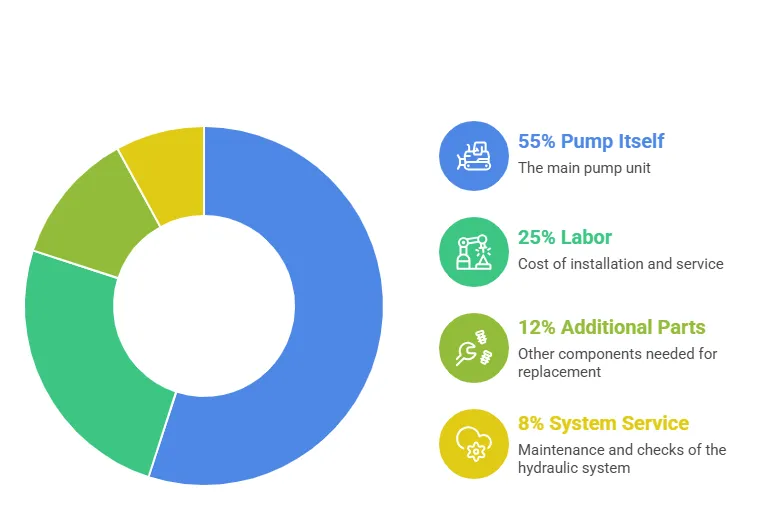
The cost nobody invoices: downtime.
Your pump costs $4,000. The job takes two days. But that excavator generates $1,500/day in billable work.
Real cost: $4,000 + labor + $3,000 lost revenue = $8,500+ total impact.
For manufacturing lines, multiply that by ten. I’ve seen injection molding operations lose $20,000 per day when a main pump goes down. At that point, expedited air freight for a $6,000 pump at a 50% premium is actually the cheap option.
If you’ve got one excavator and it breaks, you deal with it. If you’re running a fleet of 15 units with the same pump, hydraulic pump repair cost planning requires a different mindset entirely.
Stock smart, not deep.
For critical pump models running in 3+ machines, keeping one spare on the shelf usually makes sense. Do the math:
Spare pump sitting in inventory: $4,000 + storage cost + tied-up capital = maybe $4,500/year true cost.
Emergency when you don’t have one: expedited shipping ($800+) + extended downtime (3+ extra days at $1,500/day) = $5,300+ per incident.
One emergency per year and that spare paid for itself.
Build relationships, not just purchase orders.
Volume means leverage. Commit to a supplier and you’ll see 10–20% come off parts pricing. More importantly, you get priority when everyone else is scrambling for the same part.
Here’s how we handle fleet customers at Pozoom: you tell us what pump models you’re running, we reserve inventory for you. When you need it, it ships within 24 hours—no hunting around, no “let me check if we have that in stock.” We’ve had customers call on a Friday afternoon with a machine down, pump on a truck Monday morning. That’s the difference between having a supplier and having a partner.
For the bigger accounts, we set up dedicated tech support lines. Your guys have questions at 2 AM because they’re trying to get a machine running for a morning pour? Someone picks up. Volume pricing kicks in too—the more you commit, the better the numbers get. Simple as that.
Track your data.
When you know your Kawasaki K3V112 pumps consistently hit 7,500 hours before needing attention, you can schedule rebuilds during winter slowdowns instead of reacting to failures during your busiest season.
That’s the difference between a maintenance program and a fire drill.
The cheapest hydraulic pump repair is the one you never need. Change filters on schedule. Watch your oil condition—contamination causes 70-80% of pump failures. Fix leaks immediately. Keep temps in the 100-140°F sweet spot.
Alright, let’s make this practical. Here’s how to estimate what you’re actually looking at:
Step 1: Nail down the pump specs
Step 2: Get pump pricing
Step 3: Estimate labor
Step 4: Don’t forget the extras
Step 5: System service
Step 6: Add it up
How long do these things actually last?
Depends on how you treat them. Gear pumps: 5,000–10,000 hours. Vane pumps: 8,000–15,000 hours. Piston pumps: 8,000–20,000 hours. Run dirty oil, overheat them, or cavitate them regularly? Cut those numbers in half. I’ve seen well-maintained Rexroth pumps go 25,000 hours. I’ve also seen abused ones die at 2,000.
Can I do this myself?
On a small machine with good access? If you’ve got hydraulic experience and the right tools, sure. On a big excavator or anything with integrated controls? Probably not worth the risk. One misaligned coupling and you’re buying another pump in 500 hours.
Should I rebuild a cheap pump?
Usually no. If rebuild costs hit 40% of a new budget pump’s price, just replace it. Save rebuilding for the expensive stuff where it actually makes financial sense.
Where do I find my pump’s model number?
Data plate on the housing. Can’t read it? Measure the mounting flange pattern, port sizes, and shaft diameter. Most decent suppliers can cross-reference from that.
Hydraulic pump repair runs anywhere from a few hundred bucks for a seal kit to $25,000+ for a full replacement on heavy equipment. Most jobs land in the $1,500–$5,000 range when you add up parts, labor, and the stuff nobody told you about upfront.
Know your pump. Get multiple quotes. Factor in everything—not just the shiny new part. And for anything critical, remember that the cheapest repair is the one you planned for, not the one that caught you with your pants down.
Not sure whether your pump needs a rebuild or a full replacement? Send us the model number and we’ll run the numbers for you—what a new one costs, what a rebuild runs, what makes sense for your situation. We turn quotes around in 24 hours, and if we don’t carry what you need, we’ll tell you straight instead of wasting your time. That’s just how we operate.
[1] Rebuilt pump service life data referenced from Fluid Power Journal technical publications. Results vary based on rebuild quality, parts sourcing, and operating conditions.
[2] Pricing compiled from OEM price lists, distributor quotes, and our shop’s actual purchasing data through Q1 2025. Market conditions change—verify current pricing before committing.
[3] Labor hour estimates based on 15+ years of service records across excavator, industrial, and mobile equipment applications.


