
Hydraulic fittings connect every hose, tube, valve, and actuator in a pressurized circuit. Choose the wrong type, install it carelessly, or skip routine checks — and a single fitting failure can shut down an entire machine. This guide is written for maintenance technicians, equipment supervisors, and hydraulic system specifiers who need practical clarity on the six major fitting standards, what drives a correct selection, and how to keep connections leak-free over thousands of operating hours. Whether you're servicing a single skid steer or managing fittings across a mixed fleet, the fundamentals covered here apply.
A hydraulic fitting creates a sealed mechanical connection between two components in a fluid power circuit. Pumps generate pressure, valves direct it, and cylinders convert it into linear force — but none of that works if the connections between them leak. Fittings handle two jobs simultaneously: they maintain a fluid-tight seal under operating pressure, and they allow technicians to assemble and disassemble the circuit for maintenance without cutting or welding.
The complication is that there is no single universal fitting standard. Depending on the equipment's country of origin, the system pressure, the fluid type, and the environment, you might encounter half a dozen thread styles and sealing methods on the same machine. A compact excavator built in Japan and sold in the United States can have JIC connections on the hose assemblies, BSP ports on the imported control valve, and NPT threads on the locally sourced pressure gauge. Recognizing what you're looking at — and knowing what mates with what — is the first step toward leak-free hydraulics.
Every hydraulic fitting falls into one of two sealing categories: those that seal on the threads themselves (like NPT), and those that use a separate sealing surface — an O-ring, a flare, or a flat face — while the threads simply provide clamping force. This distinction matters more than memorizing part numbers, because it determines how you install, torque, and maintain each connection.
The JIC fitting is probably the most common hydraulic connection in North American mobile and industrial equipment. Defined by SAE standard J514, the male end has a 37-degree cone that presses against a flared tube or hose end. Metal-to-metal contact forms the seal — no O-ring required. That simplicity is the strength: JIC fittings are reusable, easy to inspect, and tolerate repeated assembly cycles without losing seal integrity. The trade-off is that they are more sensitive to surface finish than O-ring fittings. A nick on the flare seat that you can catch with a fingernail is enough to cause a slow weep at 3,000 PSI.
One thing worth noting: JIC and SAE 45° flare fittings look similar but are not interchangeable. The flare angles are different (37° vs. 45°), and mating the two will damage both sealing surfaces. This mix-up is common in shops that handle both hydraulic and automotive work — an automotive 45° fitting gets grabbed from the wrong bin, threads in, and leaks.
ORB fittings use straight (non-tapered) threads with an O-ring seated in a groove on the male fitting. The O-ring compresses against a machined chamfer in the female port to create the seal, while the straight threads provide holding force without contributing to sealing. This makes ORB connections more forgiving during reassembly than JIC or NPT — the O-ring does the work, so minor thread damage doesn't automatically mean a leak. ORB is the dominant port standard on most modern hydraulic valves, including the directional control valves used in mobile equipment.
ORFS takes leak resistance a step further. The O-ring sits on a flat face rather than in a boss chamfer, and it compresses against a matching flat surface on the mating fitting. According to Parker Hannifin's Seal-Lok product data, ORFS fittings provide proven vibration resistance and are highly resistant to over-torque — withstanding up to 200% of rated torque without damage. These fittings meet or exceed SAE J1453 and ISO 8434-3 requirements.
If you work on equipment that runs in high-vibration environments — paving machines, rock crushers, forestry processors — you'll see ORFS fittings at almost every critical junction. They cost more than JIC, but for circuits where a slow drip means an environmental violation or a safety hazard, the premium pays for itself.
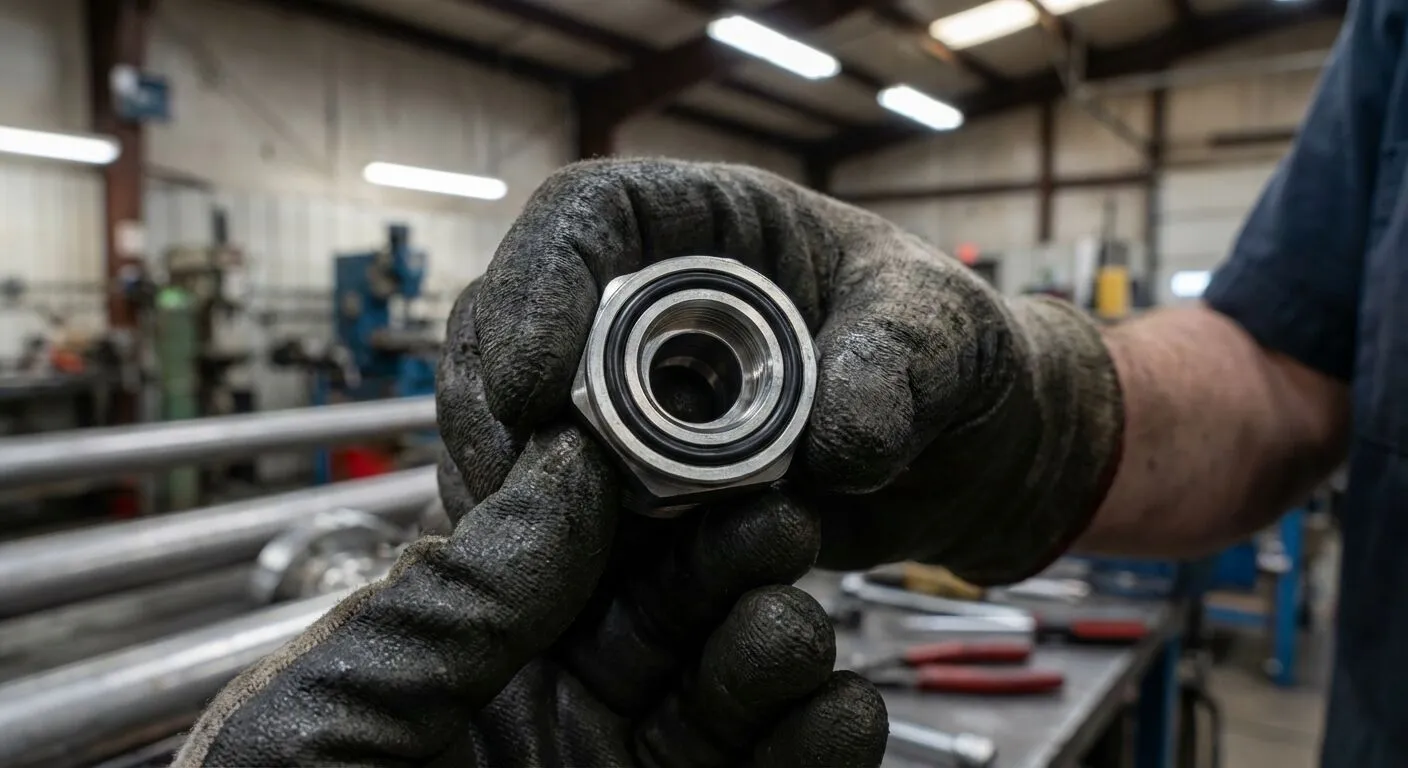
National Pipe Taper fittings seal by wedging tapered threads together, as defined by ANSI/ASME B1.20.1. The thread deformation itself creates the seal path, which is why NPT connections require PTFE tape or pipe sealant — the threads alone cannot eliminate all micro-gaps. NPT is everywhere: air lines, low-pressure return lines, gauge ports, drain plugs. But it has real limitations in high-pressure hydraulic circuits.
Here's the practical issue: every time you remove and reinstall an NPT fitting, you risk galling the threads and compromising the seal. The tapered design means the threads deform a little more with each cycle. For connections above roughly 3,000 PSI or points that need periodic service, ORB or ORFS is a better long-term choice. That said, plenty of relief valves and pressure controls still use NPT ports, so you can't avoid them entirely.
If your shop services imported European or Asian equipment, BSP threads are a fact of life. BSPT is tapered (similar concept to NPT but with a 55° thread angle versus NPT's 60°), while BSPP is parallel and typically seals with a bonded washer or an O-ring.
The most common mistake is assuming BSP and NPT are interchangeable because they look similar. They are not. A 1/2" NPT male will thread partway into a 1/2" BSPP female port, feel like it's seating, and then leak under pressure. This confusion comes up frequently in mixed-fleet shops — a technician assumes the threads match, forces the connection, and ends up cross-threading an imported valve body. The thread angle difference is only 5 degrees, but it's enough to prevent a proper seal and — if forced — damage the port permanently.
Common on German-built equipment (Bosch Rexroth, Hawe, Bucher), metric fittings typically use a 24-degree cone seat with a cutting ring or a compression olive on the tube. They are precision-machined, leak-resistant, and relatively unfamiliar to technicians trained exclusively on SAE standards. When you encounter metric ports, the critical step is measuring the thread pitch with a gauge — not eyeballing it. Metric and BSP threads overlap in some sizes, and forcing the wrong fitting can destroy the port.
| Fitting Standard | Sealing Method | Vibration Resistance | Reassembly Tolerance | Sealant Required? | Best Use Case |
|---|---|---|---|---|---|
| JIC (SAE J514) | 37° metal-to-metal flare | Good | Moderate — flare damage = leak | No | General hydraulic hose and tube connections |
| ORB (SAE J1926) | O-ring in boss chamfer | Good | High — O-ring is replaceable | No | Valve ports, manifolds, pump connections |
| ORFS (SAE J1453) | O-ring on flat face | Excellent | High — flat face is durable | No | High-vibration, zero-leak-tolerance circuits |
| NPT (ANSI B1.20.1) | Tapered thread wedge | Poor | Low — threads degrade with each cycle | Yes (PTFE tape or pipe dope) | Low-pressure lines, drain plugs, gauge ports |
| BSP (BS 21 / ISO 228) | Taper (BSPT) or washer/O-ring (BSPP) | Moderate | Moderate | BSPT: yes / BSPP: no | European and Asian OEM equipment |
| Metric DIN (ISO 8434-1) | 24° cone + cutting ring | Good | Moderate — ring must be intact | No | German OEM systems (Rexroth, Hawe, Bucher) |
Fitting selection goes wrong when people choose by size alone. The fitting that threads in is not necessarily the fitting that belongs there. Five factors drive a correct selection — roughly in order of consequence if you get them wrong.
System pressure. Every fitting has a maximum working pressure rating, and it must exceed the peak system pressure — not just the nominal pump output. Pressure spikes from cylinder end-of-stroke, relief valve cracking, or water hammer can significantly exceed steady-state readings. A fitting rated at 3,000 PSI in a 2,800 PSI circuit has almost no safety margin. Size for the worst case, not the nameplate.
Connection standard compatibility. Match the fitting to the port. This sounds obvious, but in mixed-fleet shops it's the number-one source of cross-threading and forced connections. If you're unsure, measure the thread OD, check for taper, and use a pitch gauge before you pick up a wrench. The four-step thread identification method from Parker's engineering blog is a reliable field procedure.
Material and corrosion resistance. Carbon steel fittings handle the vast majority of mineral-oil hydraulic circuits. Stainless steel is required for offshore, food-grade, or chemical environments. Brass is fine for low-pressure pneumatics but fails quickly under hydraulic pressure. Never mix dissimilar metals without considering galvanic corrosion — a stainless fitting threaded into an aluminum manifold will corrode the manifold, not the fitting.
Vibration and environment. High-vibration applications demand fittings with positive mechanical sealing — ORFS or JIC with lock nuts — rather than tapered thread connections that can back out over time. Machines that operate outdoors year-round also need fittings with corrosion protection: zinc plating at minimum, or stainless in marine and coastal environments.
Serviceability. Will this connection be disassembled regularly? JIC and ORFS fittings are designed for repeated make-and-break cycles. NPT is not — each removal risks thread damage. Choosing the wrong style for a high-service point creates cumulative maintenance problems that compound with every repair cycle.
A cracked NPT port boss is one of the most avoidable failures in hydraulic work. The typical pattern: a fitting weeps, someone tightens it another quarter turn, it weeps again, they tighten again — and on the third attempt the casting cracks. The fitting is fine; the valve body is scrap. That kind of escalation almost always starts with one of these errors:
Mixing NPT and BSP. As noted above, the thread angles are close enough that the fittings will engage but different enough that they won't seal. Forced assembly cross-threads the port. The fix: measure thread pitch before connecting anything to an unfamiliar port. Keep a pitch gauge in the toolbox — it takes ten seconds.
Applying PTFE tape to straight-thread fittings. ORB and ORFS fittings seal with O-rings, not threads. Wrapping them in tape prevents the fitting from seating fully, which actually causes the leak. This is a common error: an ORB fitting wrapped in tape, leaking, and the O-ring gets blamed when the real problem is the tape preventing proper seat contact.
Using a 45° SAE flare fitting in a JIC 37° seat. The two standards share some thread sizes (dash -2, -3, -4, -5, -8, -10), which means they physically screw together. But the flare angles are incompatible, and the result is a connection that leaks from day one. If both fitting types are in the same parts bin — a common situation in shops that also do truck or HVAC work — a labeling system prevents expensive mistakes.
Ignoring torque specifications. Both over-tightening and under-tightening cause leaks. Over-torqued JIC flares crack; overtorqued ORB fittings extrude the O-ring past its groove. Under-torqued fittings weep immediately. Use a torque wrench and follow the manufacturer's published values. "A little more" is how valve bodies crack.
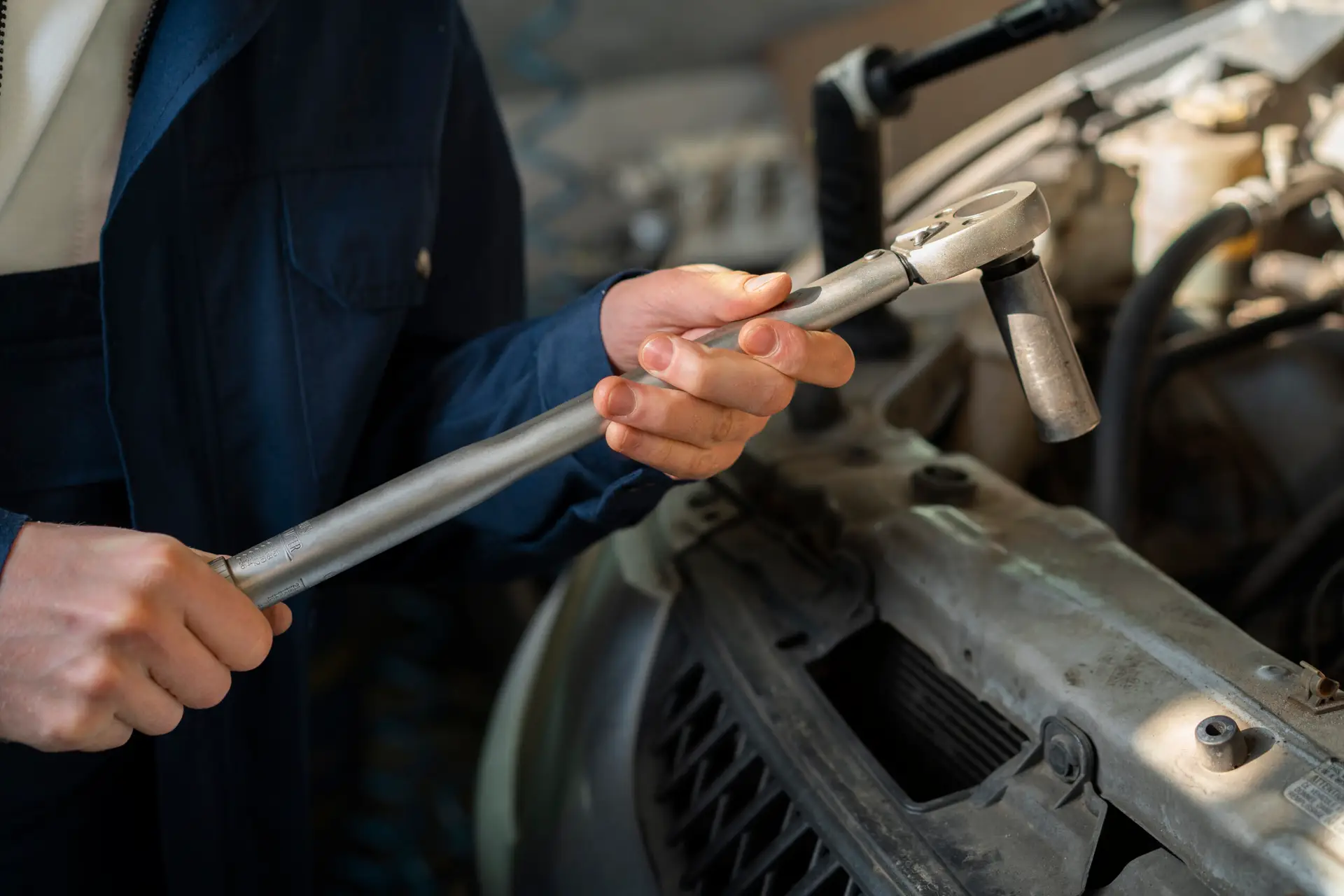
Most fitting leaks trace back to installation, not to the fitting itself. Beyond correct torque — covered above — cleanliness matters almost as much. A single metal chip trapped in an O-ring groove creates a leak path that no amount of tightening will fix. Before assembly, blow out the port with clean, dry air. Inspect the O-ring — if it has a flat spot, a cut, or has taken a compression set, replace it. O-rings cost cents. The downtime from a leak costs hours.
Thread sealant belongs only on tapered threads (NPT, BSPT). For straight-thread fittings (ORB, ORFS, BSPP), a light film of clean hydraulic oil on the O-ring is all that's needed — it helps the seal seat evenly and prevents pinching during assembly. If you're assembling a new hose run with multiple connections, pressurize the circuit to working pressure and inspect every joint before putting the machine into service. Catching a bad connection on the bench costs minutes; catching it after a hose blows costs the rest of the shift.
Hydraulic fittings don't wear out the way pumps and seals do, but they don't last forever either. Vibration loosens connections. Pressure cycling fatigues flare seats. Corrosion weakens plating. UV and weather degrade external O-rings. A maintenance program that catches these issues early prevents the cascade failure where one dripping fitting contaminates the fluid, scores a valve spool, and turns a simple O-ring replacement into a main control valve rebuild.
Inspect fittings visually every time you service the machine. Look for staining or wet spots around connections — hydraulic oil attracts dust, so a dirty ring around a fitting usually means a slow leak. Check for corrosion, especially where dissimilar metals meet. Confirm that swivel fittings still rotate freely; a seized swivel transfers hose movement directly to the fitting thread and will eventually crack the port.
On high-vibration equipment, torque-check critical fittings at every scheduled service interval. A fitting that loosened once will loosen again unless the root cause — typically inadequate support or a missing clamp — is addressed. Add clamps or brackets to restrain hose runs so that pump pulsation and machine movement don't work the fittings back and forth.
Replace O-rings proactively during any connection disassembly. Even if the old O-ring looks fine, it has already taken a compression set and its sealing reliability is reduced. Keep a kit of common O-ring sizes stocked at the machine or in the service truck — the cost of an O-ring is negligible compared to the downtime from waiting on one.
No. NPT threads follow ANSI/ASME B1.20.1 with a 60° thread angle; BSP threads follow BS 21 / ISO 7-1 with a 55° angle. The pitch profiles also differ. A 1/2" NPT may thread partway into a 1/2" BSP port, but the connection will not seal properly and risks cross-threading the port. Use a certified NPT-to-BSP adapter if you need to bridge the two standards.
JIC fittings have a visible 37-degree cone or flare on the nose — the sealing surface is angled. ORB fittings have a straight cylindrical body with an O-ring groove machined near the thread end. If both are the same nominal size, the thread pitch will differ: JIC uses UN/UNF threads while ORB uses a straight SAE thread. A thread pitch gauge removes the guesswork entirely.
The three most common causes are: an O-ring that was pinched or cut during assembly, incorrect torque (either under or over), and sealant applied to a straight-thread fitting where it doesn't belong. Disassemble, inspect the sealing surfaces under good light, replace the O-ring with a new one, reassemble to the manufacturer's specified torque, and retest.
Fittings themselves don't have a universal replacement interval — it depends on the connection type, operating conditions, and cycle count. Replace O-rings at every disassembly as standard practice. Replace the entire fitting if you see thread damage, corrosion pitting on the sealing surface, or visible cracking at the hex or port junction. For critical connections in high-cycle applications, proactive replacement at major overhaul intervals is a reasonable precaution — discuss specific intervals with your equipment or fitting manufacturer based on your operating hours and conditions.
ORFS (O-Ring Face Seal) is widely regarded as the most vibration-resistant common fitting standard. Parker Hannifin's technical data for their Seal-Lok ORFS line specifically lists vibration resistance and over-torque tolerance as primary design features, and the fittings are rated to SAE J1453 and ISO 8434-3. JIC fittings with lock nuts are the next best option. Avoid NPT connections in any high-vibration application — tapered threads back out under cyclic movement.
No. Despite sharing some thread sizes, JIC fittings use a 37° flare while SAE 45° fittings use a steeper angle. The mating surfaces will not seat correctly, and the connection will leak from the start. Forcing them together damages both parts. If your shop stocks both types — common in facilities that handle hydraulic and automotive work — label them clearly and store them separately.


