
Single Acting vs Double Acting Hydraulic Cylinders: How They Differ and When Each One Fits
We get asked this question constantly, and the answer always starts simple before it gets complicated. The mechanical difference between single and double acting hydraulic cylinders takes about thirty seconds to explain. Choosing the right one for a specific machine? That's where people get into trouble.
Last year we shipped a replacement cylinder to a concrete equipment manufacturer in Texas who'd spec'd a single acting unit for a horizontally mounted chute actuator. Gravity was supposed to handle retraction. It didn't — not reliably, not in the field, and definitely not when dried concrete added drag to the linkage. Three weeks later we shipped the double acting version that should have gone in originally. That kind of rework is avoidable, and it starts with understanding what these two cylinder types actually do differently beyond the textbook definition.
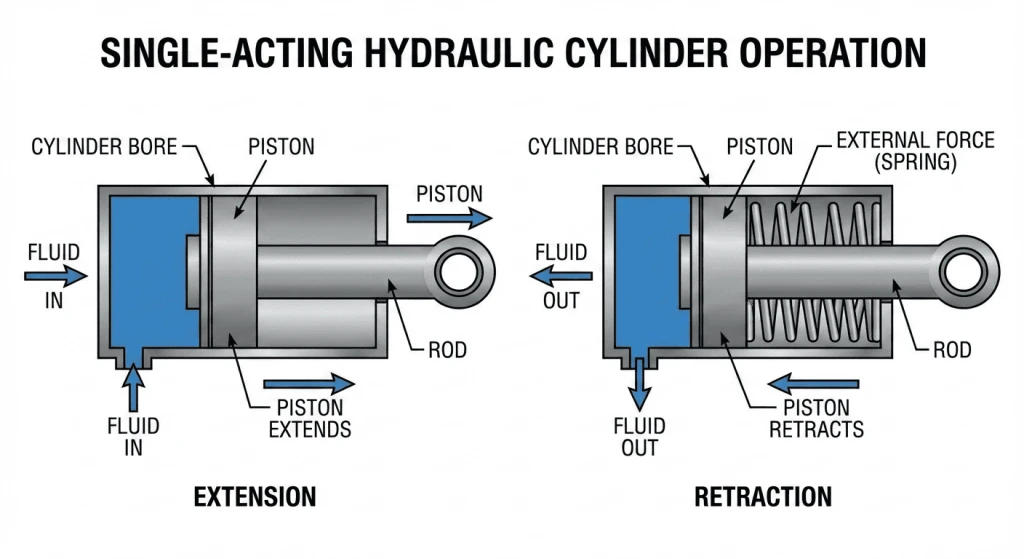
Single Acting Cylinders: One Port, One Direction of Work
A single acting hydraulic cylinder has one port. Fluid goes in, the piston extends, and that's the only stroke the hydraulics are responsible for. The return trip falls to something else — a built-in spring, the weight of the load, or occasionally a second mechanical device pushing the rod back.
This sounds limiting. Sometimes it is. But for vertical lifting applications where the load reliably pushes the piston down when pressure releases, single acting cylinders are not just adequate — they're the smarter choice. Hydraulic jacks, car lifts, forklift mast cylinders, and single-stage lift tables all use them. One hose. One fitting. Fewer seals to wear out. A simpler valve — often just a two-way. The pump can be smaller because it only needs to supply flow in one direction.
Where it falls apart is retraction control. A spring return gives you consistent-ish force early in its life, but springs fatigue. We've pulled return springs out of high-cycle single acting cylinders that had lost a third of their free length after two years of continuous service. At that point, retraction gets sluggish and inconsistent — and the operator starts compensating with workarounds that stress other parts of the machine.
Gravity return is free and doesn't wear out, but it only works when the rod points down and the load is heavy enough to overcome seal friction. Tilt the mounting angle, reduce the load, or let the rod corrode slightly and that "reliable" gravity return becomes unreliable fast.
Double Acting Cylinders: Powered in Both Directions
Two ports. One at the cap end, one at the rod end. Pressurized fluid entering the cap port extends the rod. Fluid entering the rod port retracts it. Both strokes are hydraulically powered, both are controllable through flow and pressure regulation.
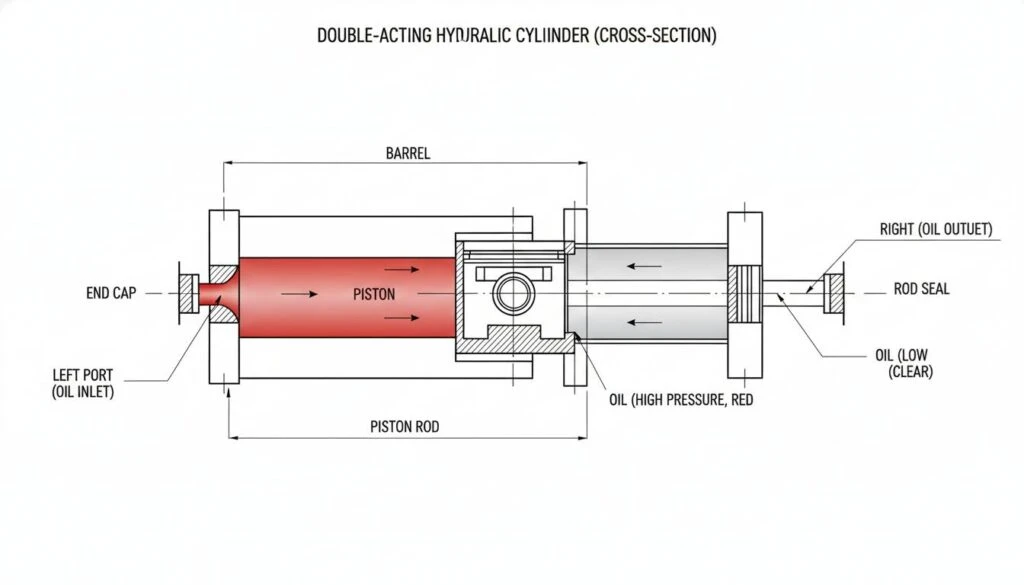
This is what you'll find on excavator booms, press rams, steering cylinders, and most industrial automation actuators. In our experience, double acting cylinders make up the vast majority of what we supply and service — not because they're always necessary, but because the applications that need them outnumber the ones that don't.
One thing we always flag for customers who are new to hydraulic circuit design: push force and pull force are not equal on a double acting cylinder. The rod occupies space on one side of the piston, so the effective area that fluid pressure acts against is smaller during retraction. On a 4-inch bore cylinder with a 2-inch rod at 3,000 PSI, you get roughly 37,700 lbs extending but only about 28,300 lbs retracting. That's a meaningful gap. If your application needs serious force in both directions — crane boom retraction, press return strokes — you need to check the area ratio early, not after the cylinder is installed. Our guide on hydraulic cylinder technical analysis walks through the efficiency and force calculations in detail.
Side-by-Side: What Actually Differs
| Feature | Single Acting | Double Acting |
|---|---|---|
| Hydraulic ports | One | Two |
| Powered stroke | Extension only | Extension and retraction |
| Return method | Spring, gravity, or external force | Hydraulic pressure |
| Retraction speed control | Minimal — depends on spring rate or load weight | Fully adjustable via flow control valves |
| Seal count | Fewer (one piston seal set, rod seal, possibly wiper) | More (two pressure-rated seal sets plus rod seal) |
| Valve requirement | 2-way valve sufficient | 4-way directional control valve required |
| Upfront cost | Lower — cylinder, pump, valving, and plumbing all simpler | Higher — more hardware, second hose run |
| Force symmetry | N/A | Extension force > retraction force (rod area difference) |
| Common applications | Jacks, log splitters, vertical lifts, clamps | Excavators, presses, steering, robotics, marine equipment |
When to Use a Single Acting Cylinder
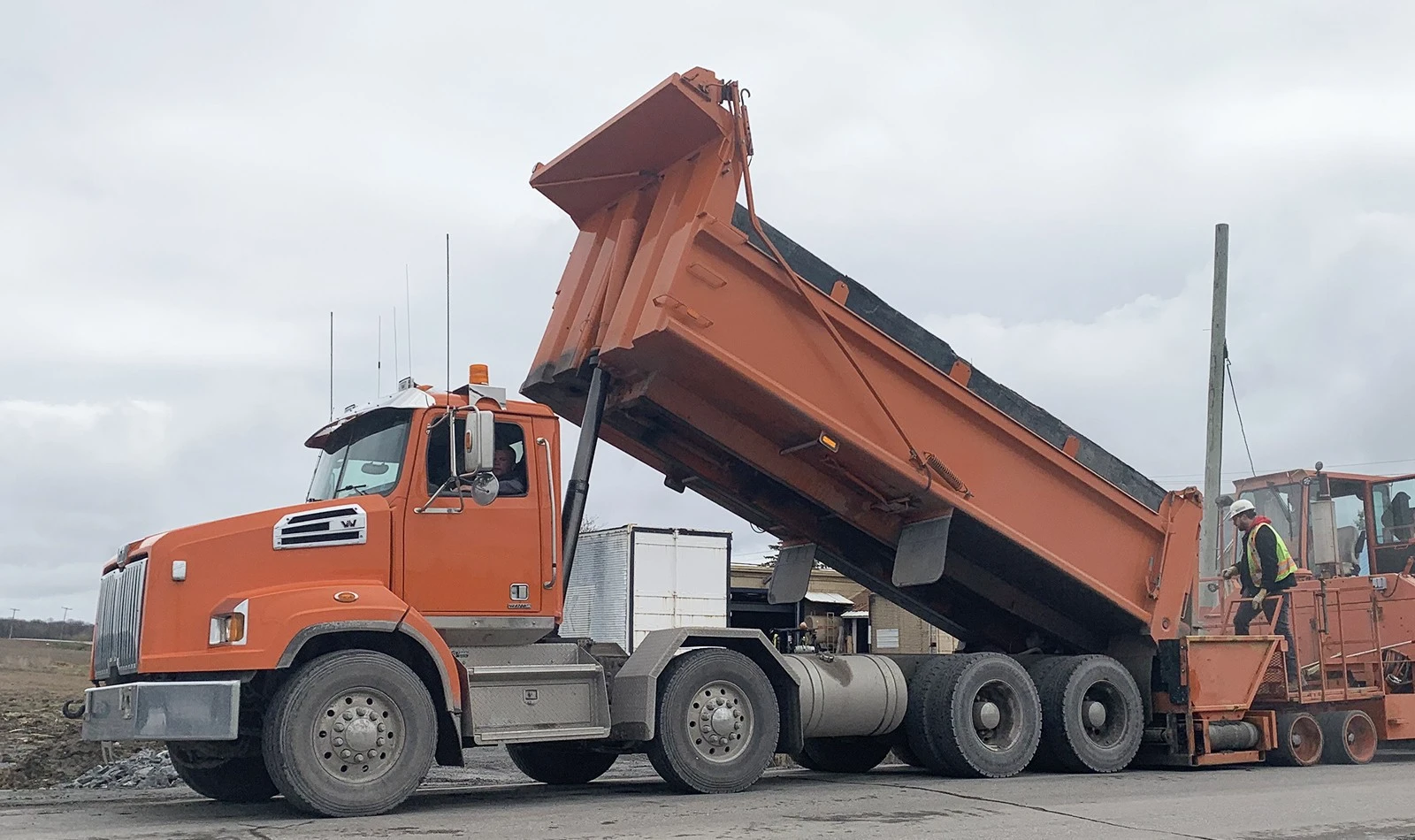
Vertical lifting with a consistent load. That's the sweet spot. Hydraulic jacks. Scissor lift tables. Dump truck telescopic cylinders — the nested stages extend under pressure, and the bed's own weight pushes them back down. For a detailed breakdown of telescopic, ram, welded, and tie-rod construction methods, see our reference on types of hydraulic cylinders.
Workpiece clamping is another solid fit. The cylinder pushes the clamp closed; a light spring opens it. Retraction force is trivial, cycle timing on the return isn't critical, and a single acting circuit per clamping station costs meaningfully less than a double acting one — savings that compound across a 12- or 24-station fixture.
One application that catches people off guard: ejection cylinders in injection molding. The cylinder fires the part out of the mold, and the mold closing action resets the ejector. Single acting works because an external mechanical force — the mold itself — handles the return. No spring needed, no gravity dependency.
When Double Acting Is the Only Real Option
Any time the cylinder is mounted horizontally or inverted, you need powered retraction. Gravity won't help you — and in the inverted case, gravity actively fights the return stroke.
Beyond orientation, it comes down to control. Excavator boom cylinders change angle constantly during a dig cycle. The operator needs to extend under load, hold position, then retract at a controlled rate while lowering a suspended load. There's no version of that workflow that works with a spring or gravity return. The consequences of uncontrolled retraction here aren't just mechanical — they're a safety hazard.
Hydraulic presses need the same bidirectional control for a different reason: cycle time. The ram extends to form the workpiece, then has to retract fast enough to keep production moving. Some press circuits use regenerative designs that route rod-side return oil back to the cap side during the approach stroke, boosting extension speed significantly. That kind of circuit sophistication is only possible with double acting cylinders. If you want to understand how fluid power multiplication and circuit design interact at a system level, our walkthrough on how hydraulic systems work covers the fundamentals.
Steering cylinders, marine deck equipment, robotic actuators, baler compression rams — the list goes on. If controlled movement in both directions isn't optional, double acting isn't optional either.
The Cost Question Isn't Just About the Cylinder
Single acting cylinders cost less. That's true at the component level, and it stays true at the system level — simpler valving, one fewer hose run, smaller pump. In our quoting experience, the total installed cost difference runs somewhere in the range of 20 to 35 percent depending on the circuit complexity, though that number shifts with bore size and operating pressure.
But here's the cost conversation people skip: what does it cost when you pick the wrong type?
We've seen this play out more times than we'd like. A machine builder specs a single acting cylinder to save money on a horizontally mounted actuator. It works on the test bench. It works fine during commissioning. Six weeks into production, the rod starts hanging up on retraction because the seals broke in and friction increased. Now the fix involves draining the circuit, pulling the cylinder, running new lines for the second port, swapping the directional valve, and adjusting the pump flow. The rework bill dwarfs the original savings — and that's before you count the production downtime.
Default to double acting when the application is ambiguous. The upfront premium is modest. The insurance value is high.
Getting the Replacement Right
Whether you're replacing a single acting or double acting cylinder, dimensional accuracy is everything. Bore determines force. Rod diameter affects retraction force and buckling resistance. Stroke defines travel. Mounting style determines whether it physically bolts up to your machine. Miss any one of those and the cylinder either doesn't fit or doesn't perform.
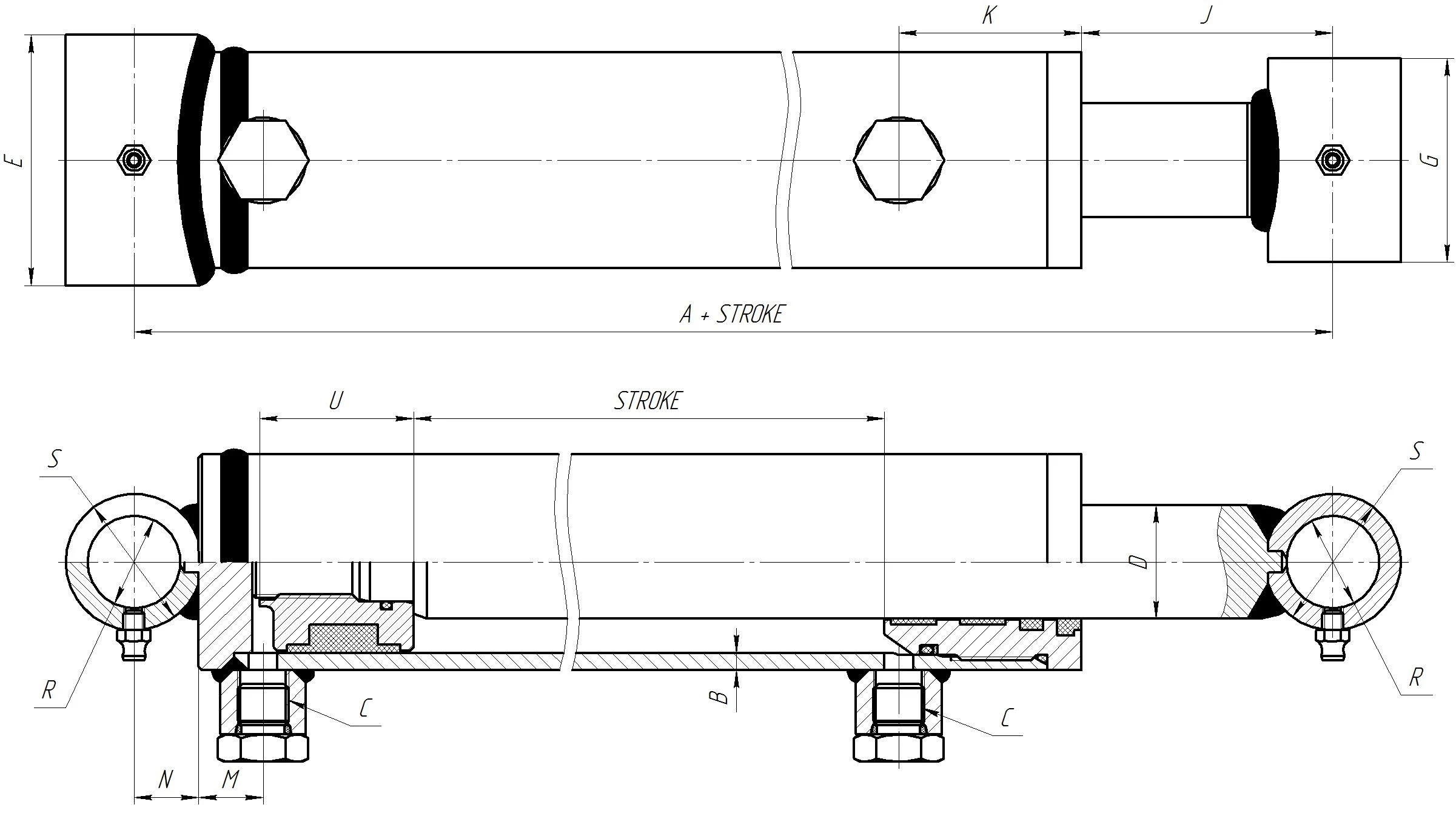
We ship replacement cylinders daily, and the most common source of delays is measurement error — especially confusing barrel outside diameter with bore, or measuring total body length instead of retracted pin-to-pin distance. Our step-by-step guide on how to measure a hydraulic cylinder covers each dimension with the tolerances and common mistakes we see most often.
They Don't Fail the Same Way
Single acting cylinders tend to fail in ways you can see. Rod seal leaks show up as oil on the rod and puddles underneath the machine. Spring fatigue shows up as sluggish, inconsistent retraction that gets worse over time. The vent port on a spring-return cylinder — the small breather that lets air in and out as the spring cavity changes volume — is a contamination entry point that's easy to overlook during routine maintenance.
Double acting cylinders have a failure mode that's sneakier: piston seal bypass. Oil crosses internally from the high-pressure side of the piston to the low-pressure side. The cylinder still moves — just slower, weaker, and hotter. There's no external drip to catch your eye. The machine "feels sluggish," cycle times creep up, and fluid temperature starts climbing for no obvious reason. Left unchecked, the excess heat degrades seals throughout the circuit and accelerates wear on the pump and valves.
Diagnosing piston seal bypass on a double acting cylinder requires a simple but specific test: run the cylinder to full stroke, hold pressure, and crack open the line on the opposite port. If oil comes out, the piston seals are gone. We use this test routinely in our service workflow — it takes five minutes and prevents the kind of shotgun parts-swapping that turns a $300 seal job into a $5,000 ordeal. For the full diagnostic methodology, including infrared temperature mapping and pressure decay testing, our technical reference on hydraulic system components and their failure interactions covers the cascade patterns we see most frequently.
How to Choose the Right Cylinder Type
We tell customers to answer three questions before anything else:
Does the application need controlled force during retraction? If the answer is yes — or even "probably" — go double acting. Steering, pressing, load lowering, and anything involving precise positioning during the return stroke all demand powered retraction.
What's the mounting orientation? Vertical with rod down and a consistent load? Single acting works. Horizontal, angled, or inverted? Double acting, no debate. Articulated equipment that changes cylinder angle during operation? Also double acting — gravity is not a reliable retraction force when the angle keeps shifting.
How many cycles per day? High-cycle applications punish spring-return designs. Springs fatigue, and inconsistent retraction cascades into timing problems, product defects, and unplanned stops. If the cylinder runs thousands of cycles daily, double acting cylinders with properly sized flow controls deliver the consistency that springs can't sustain.
When the application genuinely falls in the gray zone — a low-cycle vertical lift with moderate load, for example — single acting saves money without meaningful risk. But if you're unsure, double acting is the safer engineering call. And if the original equipment had a double acting cylinder, match it. The OEM had a reason for that choice, and "saving a few hundred dollars" is not a good reason to override it unless a custom-engineered cylinder solution specifically addresses a documented problem with the original design.
Frequently Asked Questions
Can you use a double acting cylinder in a single acting circuit?
You can — plumb fluid to one port and route the other back to the reservoir or fit it with a breather. The cylinder will extend under pressure and retract by gravity or load weight. But the open port becomes a contamination pathway if it's not properly managed, and you're paying for a second set of seals you're not using. It's a reasonable field workaround when a single acting replacement isn't available immediately, but it's not a permanent design solution.
Do single acting and double acting cylinders leak differently?
They do. Single acting cylinders most commonly leak at the rod seal — visible oil on the rod surface. The vent port on spring-return models also admits moisture and fine particles over time, which accelerates internal wear even without a visible leak. Double acting cylinders are more prone to piston seal bypass — internal leakage that produces no external drip but shows up as cylinder drift under load, slower cycle times, and rising fluid temperature. Diagnosing double acting internal leakage requires cracking the opposite port under pressure, which is a step many maintenance teams skip.
When is spring return a bad idea?
Three scenarios stand out. First: high-cycle applications where the spring will fatigue within a year or two, causing retraction to degrade progressively. Second: horizontal or inverted mounting where the spring must overcome both seal friction and gravity — the force margin shrinks and retraction becomes unreliable. Third: compact installations where the spring takes up internal space that would otherwise be usable stroke length. If any of these apply, a double acting cylinder eliminates the spring entirely and gives you powered, consistent retraction.
How do I tell whether my existing cylinder is single or double acting?
Count the hydraulic lines connected to it. One hose means single acting. Two hoses means double acting. If the cylinder is buried in the machine and the ports aren't visible, look for a small vent or breather fitting on the rod-end cap — that's typical of spring-return single acting designs. You can also check the directional valve controlling the cylinder: a 2-way or 3-way valve usually feeds a single acting cylinder, while a 4-way valve almost always feeds a double acting one.
What happens if I replace a double acting cylinder with a single acting one to cut costs?
Extension works fine. Retraction doesn't — or at least not the way the machine was designed to operate. On horizontal applications, the rod may not retract at all without powered return. On vertical applications where gravity assists, retraction becomes uncontrolled — the load drops at whatever speed gravity dictates, with no way to regulate deceleration. If the original machine relied on controlled retraction for safety interlocks or cycle timing, replacing with single acting defeats both. In our service experience, the rework cost from this type of substitution typically runs several times higher than the price difference between the two cylinder types.


