
If you run a farm tractor and need to power hydraulic implements — log splitters, post hole diggers, hay spears, dump trailers, fence post drivers — you need a PTO hydraulic pump. And if you’ve been shopping around, you’ve probably come across the Chief GP-PTO series. It shows up on almost every supplier’s site for good reason: solid build, four displacement options, and a price point that won’t make your eyes water.
But most product listings just throw spec numbers at you. They won’t tell you how to pick the right size for your tractor, what those CID and GPM numbers actually mean for your splitter speed, or what installation mistakes will kill the pump in the first season.
I’ve seen too many farmers buy a 22 GPM pump for their sub-compact tractor, only to wonder why the engine stalls every time they engage the log splitter. This guide keeps that from happening to you.
⚠️ PTO SHAFT SAFETY — READ BEFORE YOU START
PTO shafts spin at 540 or 1,000 RPM with tremendous torque. Loose clothing, hair, drawstrings, or gloves caught by a rotating PTO shaft can pull you into the machinery in a fraction of a second. PTO entanglement is one of the leading causes of fatal farm accidents in the United States.
Never wear loose clothing near an operating PTO. Never step over a spinning shaft. Always disengage the PTO and shut off the tractor before connecting, disconnecting, or adjusting the pump. Keep all PTO shields in place during operation.
A PTO hydraulic pump slides directly onto a tractor’s Power Take-Off shaft — the splined output at the rear that transfers engine power to implements. A torque arm anchors the pump body to the drawbar or 3-point hitch to keep it from spinning. The tractor’s rotational energy converts into hydraulic flow and pressure. No separate engine. No electric motor. No belt drive.
That simplicity is why PTO pumps are the go-to for farm and ranch hydraulic setups. If you want to understand how this fits into a broader hydraulic circuit, our guide on how hydraulic systems work covers the fundamentals.
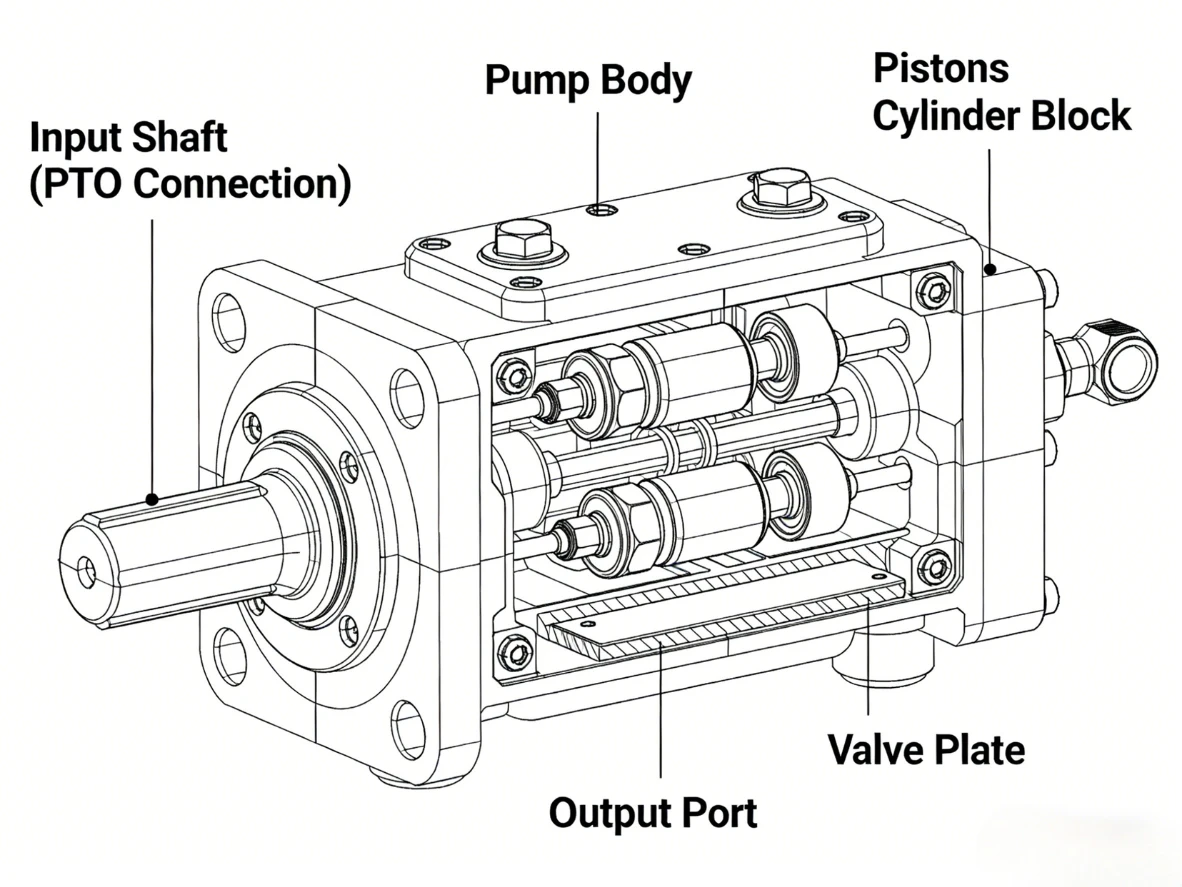
The Chief GP-PTO is a fixed-displacement gear pump built for PTO drive. Cast iron end plates. Aluminum center section. Designed around the standard 1-3/8″ PTO shaft found on nearly every farm tractor in North America, with either a 6-tooth (540 RPM) or 21-tooth (1,000 RPM) female spline.
Four displacement sizes cover the full range:
| CID (in³/rev) | GPM @ 540 RPM | HP Required | Max PSI | Best Applications |
|---|---|---|---|---|
| 3.41 | 7.4 | 8 | 2,500 | Small log splitters, single-cylinder tools, hay spears |
| 5.50 | 12.0 | 13 | 2,500 | Mid-size log splitters, post hole diggers, dump trailers |
| 7.62 | 16.6 | 20 | 2,500 | Heavy log splitters, fence post drivers, multi-function systems |
| 9.76 | 22.1 | 25 | 2,500 | Large implements, high-flow circuits, multiple cylinders |
The 7.62 CID / 16.6 GPM model hits the sweet spot. Enough flow for fast log splitter cycles, 2,500 PSI for hard work, and the 20 HP requirement fits mid-size and full-size tractors from John Deere, Kubota, New Holland, and Massey Ferguson.
Since “what size pump for my tractor?” is the question we hear most, here are real-world pairings that work:
| Tractor Class | Example Models | PTO HP (approx.) | Recommended Chief GP-PTO |
|---|---|---|---|
| Sub-Compact (20–30 HP) | Kubota BX, JD 1025R, Kioti CS | 14–22 | 3.41 CID (7.4 GPM) |
| Compact (30–50 HP) | Kubota L series, JD 3E/4M, NH Workmaster | 22–38 | 5.50 CID (12 GPM) or 7.62 CID (16.6 GPM) |
| Utility (50–80 HP) | JD 5 series, Kubota M series, MF 4700 | 38–62 | 7.62 CID (16.6 GPM) — sweet spot |
| Row-Crop (80+ HP) | JD 6 series, Case Maxxum, NH T6 | 62+ | 9.76 CID (22.1 GPM) — use 1,000 RPM option |
These are starting points, not guarantees. Always verify your specific tractor’s PTO horsepower rating in the owner’s manual — it varies by model year and configuration.
If your tractor didn’t make the table above, or you’re building a custom system, here’s how to size it yourself.
Flow controls cylinder speed. The formula:
GPM = (Cylinder Area in² × Stroke inches × Cycles/min) ÷ 231
A typical log splitter — 4″ bore, 24″ stroke, 4 cycles/minute — needs about 5.2 GPM. But that’s theoretical. Real-world valve losses, hose friction, and the fact that published GPM ratings assume zero-load conditions mean you need a 50% safety factor. That 5.2 GPM need calls for 8–10 GPM minimum. Want a fast splitter? 16.6 GPM gives you serious cycle speed.
Force (lbs) = PSI × Bore Area (in²)
A 4″ bore at 2,500 PSI delivers roughly 31,400 lbs of splitting force. All Chief GP-PTO models handle 2,500 PSI continuous.
This is where people get burned. Engine HP ≠ PTO HP. Drivetrain losses eat 15–20%. A 50 HP tractor might only put 40 HP at the shaft.
HPrequired = (GPM × PSI) ÷ (1,714 × η)
Where η (eta) = pump volumetric efficiency, typically 0.85 for gear pumps
Example: (16.6 × 2,500) ÷ (1,714 × 0.85) = 28.5 HP required at PTO
That means a tractor with at least 35–40 engine HP to safely run the 7.62 CID pump at full load.
⚠️ If your tractor doesn’t have enough PTO HP, the engine lugs, ground speed drops, and hydraulic oil overheats because the pump struggles at low RPM with high load. Match pump demand to tractor capacity — never the other way around.
540 RPM — the slower standard. Virtually all compact and utility tractors. 6-tooth spline, 1-3/8″ diameter. Most Chief GP-PTO models ship this way.
1,000 RPM — the faster standard, common on 75+ HP tractors. 21-tooth spline, same 1-3/8″ diameter. Available on select Chief models with significantly higher GPM at the same displacement.
Wrong match = disaster. A 540 RPM pump on a 1,000 RPM PTO nearly doubles flow and HP demand — blowing past the pump’s internal bearing and seal limits. A 1,000 RPM pump on a 540 RPM PTO gives you half-speed flow. Neither ends well.
Check your PTO stub. Count the teeth. It takes 10 seconds and saves hundreds of dollars.
Without a torque arm anchoring the pump body to the drawbar, the entire housing tries to spin with the PTO shaft. Works for about 10 seconds before the hoses wrap around the shaft and rip out. Always restrain the pump body.
Gear pumps need oil at the inlet from the very first revolution. Before startup, fill the pump housing through the outlet port with clean hydraulic oil. Start at low idle — not full RPM — and circulate for 30 seconds before applying load. Skip this step and you’ll score the gear faces and bearing journals before the pump has been running for 60 seconds.
A restricted inlet starves the pump, causing cavitation — destructive vapor bubbles that chew up gear faces. For a 16 GPM pump, use minimum 1″ ID suction hose. Bigger is always better on the suction side. Keep the reservoir above the pump inlet whenever possible for gravity feed.
Every PTO circuit needs a pressure relief valve between pump outlet and directional valve. When a cylinder hits end of stroke or a load stalls, the pump keeps pushing oil with nowhere to go. Without relief, pressure spikes to destructive levels in milliseconds. Set the relief 200–300 PSI above working pressure.
Use AW (Anti-Wear) hydraulic oil. AW-46 for temperate climates. AW-32 if you operate below 20°F regularly. Never use motor oil, ATF, or “universal tractor fluid” — wrong additive packages damage gear pump internals over time.
This is the one new PTO pump owners almost always get wrong.
🛢️ Reservoir Sizing Rule of Thumb
Tank capacity should be 2–3× your pump’s GPM rating for adequate heat dissipation and air separation. A 16.6 GPM pump needs a minimum 35-gallon reservoir. Running a 5-gallon tank on a 16 GPM pump? Your oil temperature will spike past 180°F within minutes under load, accelerating seal degradation, fluid breakdown, and dramatically shortening pump life. If space is tight, add an oil cooler — it’s cheaper than a replacement pump.
These are the two brands buyers compare most. Both work. But the engineering differences matter depending on how hard you plan to run the pump.
| Feature | Chief GP-PTO | Prince PTO |
|---|---|---|
| Construction | Cast iron end plates, aluminum center | Aluminum or cast iron center options |
| Wear Compensation | Fixed wear plates | Self-adjusting wear plates (pressure-loaded) |
| Bearings | Journal (sleeve) bearings | Tapered roller bearings |
| Shaft Seals | Standard NBR (nitrile) lip seal | Double-lip Viton® seal option on heavy-duty models |
| Max Pressure | 2,500 PSI | 2,250 PSI (aluminum) / 2,500 PSI (cast iron) |
| Displacement Range | 3.41–9.76 CID | 2.0–11.4 CID |
| Expected Service Life* | 2,000–3,500 hours | 3,000–5,000+ hours |
| Price Range | $$ | $$$ |
*Service life estimates based on intermittent duty, proper oil maintenance, and operation within rated pressure. Actual life varies by application.
What the differences mean in practice: Roller bearings handle radial loads better than journal bearings and tolerate slight misalignment — they’re why Prince pumps tend to last longer under continuous heavy use. Self-adjusting wear plates automatically compensate for gear face wear, maintaining volumetric efficiency over time. The Viton® seal option on Prince resists higher temperatures (up to 400°F vs. 250°F for standard nitrile), relevant if your system runs hot.
That said, most farm PTO pumps see intermittent duty — a few hours per week at most. At that use level, the Chief’s journal bearings and fixed wear plates hold up fine, and the cost savings are significant. If your splitter or post digger runs a couple hours on Saturday, the Chief is hard to beat on value. If you’re running a commercial firewood operation 8 hours a day, spend the extra money on the Prince.
Change the oil. PTO pump systems use a separate reservoir from the tractor. Change oil and filter at 250-hour intervals — or annually, whichever comes first. Contamination is still the number one killer of hydraulic components.
Inspect the suction hose. A hose collapsing internally can starve the pump with zero visible external damage. Replace suction hoses every 3–5 years, or sooner if the hose feels stiff.
Warm it up. Cold hydraulic oil is thick. Forcing it through at full RPM causes cavitation. In cold weather, let the pump circulate at low idle with no load for 2–3 minutes before engaging.
Store it right. Cap all ports between seasons. Moisture in stagnant oil corrodes gear surfaces and bearing journals. A contaminated pump coming out of winter storage is already halfway to failure.
For a 30 HP tractor (roughly 24 PTO HP), the Chief GP-PTO 5.50 CID at 12 GPM is the reliable choice — it requires 13 HP and gives you solid splitting speed without straining the tractor. If you want faster cycles and your tractor can handle it, the 7.62 CID at 16.6 GPM works, but you’ll be close to the tractor’s PTO capacity at full load. Size up only if your tractor comfortably exceeds 28 PTO HP.
Yes — the 3.41 CID (7.4 GPM, 8 HP) fits sub-compacts with 20–25 engine HP. Don’t try the 7.62 or 9.76 CID models on a sub-compact. You’ll stall under any real load.
Yes to both. PTO pumps don’t connect to the tractor’s internal hydraulics. You need an external tank (sized at 2–3× your GPM), suction hose, return filter, and a relief valve. Many suppliers sell complete PTO pump kits with all components included.
Count the teeth on your tractor’s PTO stub shaft. 6 teeth = 540 RPM. 21 teeth = 1,000 RPM. Same 1-3/8″ diameter, but not interchangeable. Takes 10 seconds to check. Worth it.
With clean oil and correct sizing: 2,000–4,000 hours depending on duty cycle. Weekend log splitting and seasonal post driving often sees pumps last 10+ years. Continuous commercial use at peak pressure shortens that considerably.
Pozoom Hydraulic carries a full range of hydraulic gear pumps, valves, and spare parts with technical sizing support. Our catalog covers over 1,800 pump specifications across gear, vane, and piston types. Reach out to our team if you need help matching a pump to your tractor and application.
Getting the pump-to-tractor match right the first time saves money, prevents stalling, and protects your equipment.
Tell us your tractor model and application — we’ll recommend the right displacement, spline type, and system components.


