
Last January, a contractor in Wisconsin called us about a Komatsu excavator that wouldn’t swing. Temps had dropped to 5°F overnight, and when the operator fired up the machine, the swing motor barely moved. The boom was sluggish. The hydraulic pump was screaming.
The diagnosis took about 30 seconds: AW-68 hydraulic oil — a perfectly good summer fluid — had turned to syrup in the cold. The pump was trying to suck molasses through a straw. No component damage yet, but another 20 minutes of running and the pump internals would have been chewed up by cavitation.
This is what cold weather does to hydraulic systems. Not dramatic explosions — just thick oil, starved pumps, stressed seals, and expensive failures that are completely preventable. If you’ve ever searched “best hydraulic oil for cold weather” or wondered how to warm up a hydraulic system in winter without killing the pump, keep reading.
Cold doesn’t break hydraulic components directly. It attacks the fluid — and the fluid touches everything.
When temperature drops, hydraulic oil viscosity increases. The fluid gets thicker. Thicker fluid resists flow. That resistance creates a chain reaction across the entire system:
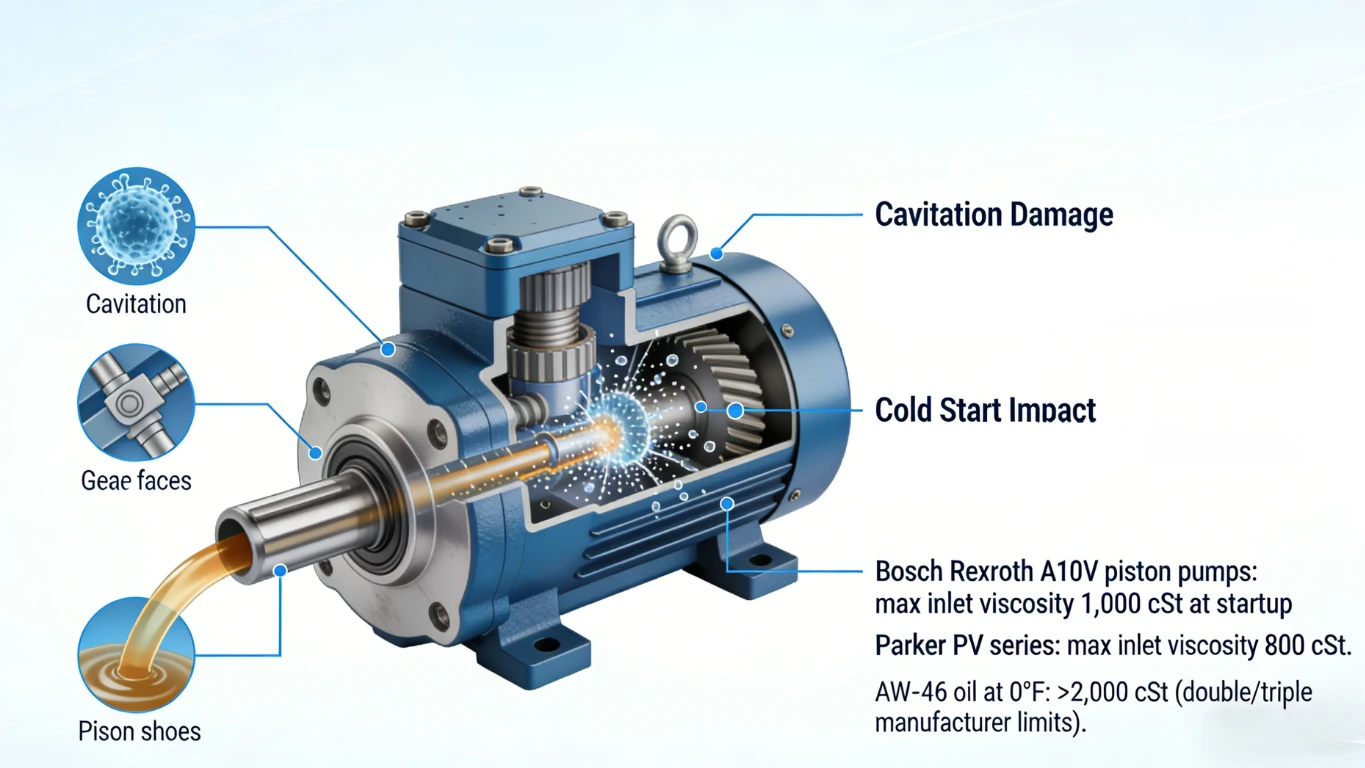
Pump starvation. The pump inlet can’t draw thick oil fast enough, creating partial vacuum inside the pump housing. That vacuum collapses into cavitation — microscopic vapor bubbles that implode against gear faces, vane tips, and piston shoes. Cavitation damage is irreversible and cumulative. Every cold start without proper warm-up shortens pump life. For reference, Bosch Rexroth specifies a maximum inlet viscosity of 1,000 cSt for their A10V piston pumps at startup; Parker’s PV series lists 800 cSt. AW-46 oil at 0°F can easily exceed 2,000 cSt — double or triple the pump manufacturer’s limit.
Excessive pressure drop. Thick oil loses more energy pushing through hoses, fittings, and valve passages. Functions that work fine at 70°F become sluggish at 20°F — not because anything is broken, but because the oil can’t move fast enough through the system’s restrictions.
Seal damage. Cold makes rubber and elastomer seals stiff and brittle. Combine that with pressure spikes from thick oil hitting relief valves, and you get cracked lip seals, leaking O-rings, and blown rod seals — often on the first cold start of the season.
Moisture condensation. Temperature swings cause condensation inside reservoirs and cylinder barrels. Water in hydraulic oil accelerates corrosion on precision-machined surfaces and degrades fluid chemistry. In severe cold, that water can freeze inside pilot lines and block valve signals entirely.
If you only do one thing to prepare for winter, get your oil right.
Hydraulic oil grades (AW-32, AW-46, AW-68) refer to viscosity at 40°C (104°F). Lower numbers = thinner oil. Here’s how common grades perform across temperature ranges:
| ISO Grade | Viscosity @ 40°C (cSt) | Usable Temp Range | Best For |
|---|---|---|---|
| AW-22 | 22 | -30°F to +130°F | Arctic/extreme cold operations |
| AW-32 | 32 | -15°F to +160°F | Cold-climate year-round, winter switch fluid |
| AW-46 | 46 | +5°F to +185°F | Most common all-season grade |
| AW-68 | 68 | +25°F to +210°F | Hot-climate, heavy continuous duty |
If your equipment operates regularly below 20°F and you’re running AW-46, you have a problem. The oil may not be frozen, but it’s thicker than your pump was designed to handle at inlet. Switching to AW-32 for winter — or using a high-VI (Viscosity Index) multi-grade fluid year-round — is the simplest protection against cold-start damage.
VI measures how much a fluid’s viscosity changes with temperature. High VI = more stable viscosity across a wider temperature range. The key relationship to remember:
Higher VI → Less viscosity change per degree of temperature drop
Lower VI → More viscosity change per degree (worse for cold climates)
Standard mineral oils sit around VI 95–105. Premium multi-grade hydraulic fluids — like Shell Tellus S4 VX or Mobil DTE 10 Excel series — can reach VI 150+, meaning they stay thin enough to pump at -20°F yet thick enough to protect at 180°F. For context, Komatsu’s cold-weather operation manual recommends a minimum VI of 130 for machines operating below -5°F, and Caterpillar’s HYDO Advanced 10W fluid is specifically formulated for wide-temperature performance. These aren’t endorsements — just benchmarks that show what the OEMs consider adequate for cold-weather hydraulics.
For equipment that operates year-round across wide temperature swings — construction, forestry, mining — a high-VI fluid often eliminates the need for seasonal oil changes altogether. More expensive per gallon, but cheaper than the labor and downtime of draining and refilling twice a year.
Switching from AW-68 to AW-32 sounds simple. Pour the new stuff in, right? Not quite.
If you drain the reservoir and refill, you’ve only changed about 60–70% of the system’s total oil volume. The rest — trapped in cylinders, hose lines, valve cavities, and the pump housing — is still thick summer fluid. That leftover AW-68 blends with your fresh AW-32 and raises the effective viscosity of the entire charge, undermining the cold-weather protection you’re paying for.
The proper approach: drain the reservoir, replace the filter, refill with the winter-grade oil, then run the system through all functions at low load for 10–15 minutes to flush old oil out of the lines and actuators. Drain and refill one more time. This gets you to 90%+ new fluid — enough for the cold-weather viscosity to actually do its job. Yes, it uses extra oil. It’s still cheaper than a cavitation-damaged pump.
Even with the right fluid grade, cold starts demand a specific warm-up sequence. Skipping it is the single fastest way to destroy pump internals.
Step 1: Let the engine idle for 3–5 minutes. This warms the pump housing and the oil immediately surrounding the gears or pistons. Don’t touch the controls yet.
Step 2: Cycle functions slowly at low RPM. Move boom, stick, bucket, and swing through short partial strokes — no full extensions, no heavy loads. This pushes warm oil from the pump through the lines and into the cylinders, warming the entire circuit gradually. The oil returning to the reservoir carries heat with it, raising tank temperature.
Step 3: Monitor oil temperature. Most OEMs recommend reaching 100–120°F before applying full load. Some systems have a temp gauge; if yours doesn’t, a handheld infrared thermometer on the return line gives you a quick read.
Step 4: Watch for abnormal noise. A pump that whines, groans, or chatters during warm-up is telling you the oil is still too thick to flow properly. Back off the RPM and give it more time. If the noise persists after 10 minutes of warm-up, the oil grade is wrong for these conditions.
🔧 Field Tip
On machines parked outdoors in extreme cold (below 0°F), consider using a reservoir tank heater — either an immersion heater or a pad heater strapped to the outside of the tank. Running a 500W heater overnight keeps the oil around 40–50°F, which eliminates the brutal cold-start viscosity spike entirely. The electricity cost is trivial compared to one cavitation-damaged hydraulic pump.
Cold weather punishes weak links. Inspect these before the first freeze:
Hoses. Flex each hose by hand. If the rubber feels stiff, cracked, or shows surface checking (tiny cracks in the outer cover), replace it. A hose that’s marginal in summer will fail in winter — cold rubber loses flexibility and can’t absorb pressure pulses. Braided steel hydraulic hoses from a reputable supplier are a worthy investment for cold-climate equipment.
Seals and O-rings. External leaks that were minor weeps in warm weather will worsen in cold. Cold-hardened seals lose their elastic memory and can’t maintain proper contact with mating surfaces. We’ve seen O-rings snap like dry twigs when hit with a 3,000 PSI pressure spike in sub-zero temps — especially the cheap imports that weren’t formulated for low-temperature flexibility. Replace any seal showing leakage before winter hits. Standard nitrile (NBR) seals handle most conditions down to about -20°F; for sustained operation below -25°F, upgrade to fluorosilicone or HNBR (hydrogenated nitrile) compounds that maintain elasticity at extreme cold.
Filters. A partially clogged filter that passes oil fine at summer viscosities can become a near-total blockage when that same oil thickens in the cold. Start winter with fresh filters. Monitor filter differential pressure gauges — if equipped — closely during the first weeks of cold operation.
Breathers and vents. Reservoir breathers clogged with ice or frozen moisture block air exchange, creating vacuum conditions inside the tank that compound pump starvation. Replace breathers and consider desiccant-type units that trap moisture before it enters the reservoir.
Equipment that runs regularly actually fares better in winter than equipment that sits. Movement circulates warm oil. Sitting lets moisture accumulate and oil settle to its coldest, thickest state.
If machinery will be parked for weeks or months during winter, take these steps:
Fully retract all cylinders. Exposed chrome rod surfaces corrode when moisture condensation freezes and thaws repeatedly on the polished surface. Retracted rods are protected inside the cylinder barrel.
Top off the reservoir. A full tank has less airspace, which means less room for moisture condensation. Partially empty reservoirs breathe in humid air as temperatures swing, and that moisture contaminates the oil.
Cap all open ports. Any disconnected hose end, open fitting, or uncapped valve port is an entry point for moisture and debris. Plastic caps cost cents; the contamination they prevent costs thousands.
Store hydraulic fluid indoors. Oil drums and jugs stored outside cycle through temperature swings that pull moisture in through the drum seal. Keep all fluid at room temperature until needed.
Standard mineral-based hydraulic oil doesn’t freeze solid like water. Instead, it reaches a pour point — typically around -20°F to -40°F depending on the grade — where it becomes too thick to flow at all. Operational problems start long before that. Most systems struggle when oil viscosity exceeds 1,000 cSt at startup, which can happen at temperatures well above pour point.
If they’re the same base type (both mineral, or both synthetic) from the same manufacturer, mixing is generally safe — you’ll end up with a viscosity somewhere between the two. That said, for consistent protection, fully drain and refill rather than blending. Clean, properly graded oil is your system’s first line of defense.
You’ll hear it — a high-pitched whine or irregular rattling from the pump that’s louder than normal operation. The pump may also vibrate noticeably. If the noise subsides as the system warms up, cold oil is the culprit. If it persists after warm-up, the problem may be a failing pump, clogged suction filter, or restricted inlet line. Learn more about diagnosing pump issues in our guide on hydraulic control solutions.
For most equipment operating between 0°F and -15°F, AW-32 mineral hydraulic oil is the standard cold-weather choice — it provides adequate film strength while remaining pumpable at low temperatures. For sustained sub-zero operation (-15°F and below), high-VI synthetic blends with VI ratings above 140 offer the best all-around protection. Specific recommendations depend on your pump type, system pressure, and duty cycle. Our engineering team can help you match the right fluid to your specific equipment and climate.
Synthetic fluids offer superior cold-flow properties and much higher VI than conventional mineral oils. They’re the best choice for equipment operating in sustained sub-zero conditions. The tradeoff is cost — synthetics run 3–5× the price of mineral oil. For most operations that see occasional cold, switching to a lower-grade mineral oil (AW-32) or a high-VI mineral blend is more cost-effective.
From replacement pumps and valves to seals, filters, and spare parts — Pozoom Hydraulic stocks over 7,000 components with technical support to help you prepare for cold-weather operation.


