
Picture this: A 50-ton excavator bucket lifting a car like it’s a toy, powered by a motor no bigger than a basketball. That’s hydraulic power in action.
But here’s what surprised me when I dug into the mechanics: The principle is dead simple—pressurized fluid pushing against internal components. Yet the engineering that makes this reliable enough to run for 20,000 hours in a dirt-filled construction site? That’s where it gets fascinating.
The difference between understanding “fluid pushes things” and actually grasping how hydraulic motors convert energy determines whether you choose a $500 gear motor that fails in six months or a $3,000 piston motor that runs for a decade. Let me show you the mechanics that separate these outcomes, using a framework I developed after analyzing how each design handles energy transformation differently.
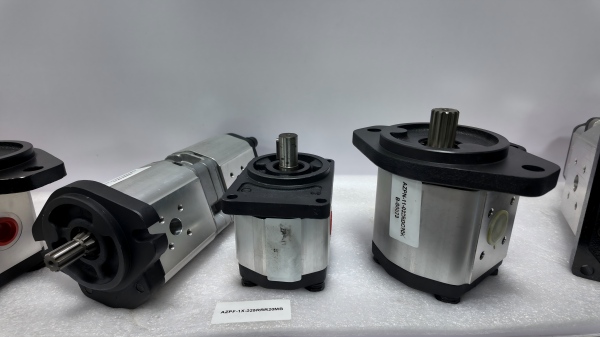
Every hydraulic motor does one job: convert hydraulic pressure into rotational mechanical power. The hydraulic pump creates flow and pressure, pushing incompressible fluid (usually oil) through the system. When this pressurized fluid enters the motor, it forces internal components—gears, pistons, or vanes—to move, creating torque on an output shaft.
The fundamental equation that governs this: Torque = (Pressure × Displacement) / (2π)
What’s not obvious from this equation is that how the motor achieves this transformation completely changes its performance envelope. A gear motor and a piston motor might both convert 3,000 PSI into rotation, but they do it through radically different mechanical paths—and those paths determine everything from efficiency to failure modes.
The critical insight? The internal geometry of how fluid pressure acts on moving parts creates distinct “energy conversion personalities” for each motor type. Understanding these personalities is the key to selecting the right motor.
Hydraulic systems use oil (not water, despite some historical applications) because it’s virtually incompressible. When you apply 3,000 PSI to one end of a sealed hydraulic line, you get 3,000 PSI at the other end—instantly. No delay, no compression loss.
This creates what I call “rigid power transmission.” Compare this to compressed air systems where pressure drops significantly over distance, or mechanical linkages where you lose energy to friction and flex. Hydraulic fluid becomes, in effect, a solid rod of force that can bend around corners and split into multiple paths.
But here’s the trade-off most people miss: That same incompressibility means any trapped air becomes catastrophic. Even 1% air contamination can cause pressure spikes, cavitation, and premature wear. According to industry studies, air contamination accounts for up to 90% of hydraulic motor failures—a problem that traces directly back to this fundamental property.
After analyzing dozens of hydraulic motor designs, I noticed they cluster into five distinct approaches to energy conversion. Each approach optimizes for different variables, creating performance envelopes that rarely overlap.
Here’s the framework I use to categorize them—what I call the Energy Transformation Matrix:
Type 1: Balanced Force Motors (Gear Motors)
Type 2: Orbital Force Motors (Gerotor/Orbital Motors)
Type 3: Sliding Force Motors (Vane Motors)
Type 4: Reciprocating Force Motors – Radial (Radial Piston Motors)
Type 5: Reciprocating Force Motors – Axial (Axial Piston Motors)
Notice the efficiency progression? It’s not arbitrary. Higher efficiency always costs more—in money, size, or complexity. The 2024 Global Hydraulics Market Report valued at $44.08 billion projects that piston motors (Types 4 & 5) will capture increasing market share specifically because industries can now justify their 15-30% higher cost against long-term energy savings.
Let me break down each type’s working mechanism, because the details reveal why each design dominates specific applications.
Take two identical gears meshing together inside a tight housing. Seal one end, leave the other open. Now pump high-pressure oil into the sealed side.
The oil can’t compress, can’t flow between the meshed gear teeth, so it takes the only path available: flowing around the outside of the gears between the gear tips and housing wall. As it flows, it pushes on each gear tooth, creating torque. Both gears rotate, but only one connects to the output shaft.
The idler gear? It’s not wasted. It creates a pressure seal, preventing oil from flowing backward from the low-pressure outlet back to the high-pressure inlet. This is why gear motors are “external gear” designs—the gears are outside the pressurized flow path, acting as both rotor and seal.
Here’s what separates a $400 gear motor from a $1,200 one: tooth profile precision. The closer the gear tips approach the housing wall, the less internal leakage—and leakage directly determines volumetric efficiency.
Manufacturing tolerances of 10 microns (0.0004 inches) are standard for quality gear motors. At 3,000 PSI operating pressure, even a 20-micron gap can leak enough oil to drop efficiency from 85% to 75%. Over a motor’s 10,000-hour lifespan, that’s thousands of dollars in wasted energy.
But there’s a counter-intuitive aspect: some leakage is intentional. That small amount of oil flowing past the gears lubricates the bearings and cools the internal components. Too tight tolerances and the motor overheats. Too loose and it leaks. Quality manufacturers tune this to a razor’s edge.
In 2024, gear motors account for roughly 28% of the global hydraulic motor market despite their lower efficiency. Why? Three reasons:
Applications? Agricultural equipment, conveyor systems, fan drives, and small mobile machinery. Anywhere you need reliable rotation at reasonable torque without breaking the budget.
Real-World Example: John Deere tractors use gear motors for implement drives (augers, conveyors) because the tractors already generate hydraulic pressure for other functions. Adding another $600 gear motor costs less than running a separate electric motor with its required wiring, controls, and protection.
Stand an internal gear (rotor) with N teeth inside an external gear ring (stator) with N+1 teeth. The rotor orbits—not just rotates—inside the stator. As it orbits, the volume of each pocket between rotor and stator alternately expands and contracts.
Pump high-pressure oil into the expanding pockets and you create an imbalanced force. The rotor wants to orbit to keep those pockets expanding. Connect the rotor to an output shaft through a mechanical coupling and you get rotation.
The genius? The rotor makes only one orbit per shaft revolution, but the fluid acts on multiple lobes simultaneously. This creates extraordinarily high torque at low speed. An orbital motor with 7 lobes develops 7 times the torque of a piston motor with similar displacement.
Most orbital motors operate between 0-800 RPM, with some variants pushing to 1,500 RPM. But they produce torque densities that seem impossible: 10,000 in-lbs (1,130 Nm) from a unit weighing 40 pounds.
The mechanical principle? Multiple pressure chambers acting simultaneously. At any moment, 3-5 lobes are experiencing pressure differential, all contributing to rotation. Compare this to a gear motor where only 1-2 teeth are under pressure at once.
But (and this is critical) that same principle creates internal stress that prevents high-speed operation. Push an orbital motor past 1,500 RPM and bearing loads skyrocket. The lobes slam into each other with increasing force. Failure becomes inevitable.
In 2024, orbital motors cost 40-60% less than piston motors with similar torque capacity. Market data from Grand View Research shows orbital motors capturing 35% of the construction equipment segment, specifically because excavator swing drives and wheeled loader drives need high torque but rarely exceed 100 RPM.
Counterintuitive Fact: Orbital motors actually waste less energy as heat compared to gear motors, despite what many assume. Their volumetric efficiency typically hits 88-93% because the tight tolerances between rotor and stator minimize leakage. The heat issue with orbitals comes from mechanical friction in the internal gearing, not hydraulic losses.
Imagine a rotor with slots cut radially. Slide flat vanes into those slots. Now spin the rotor. Centrifugal force pulls the vanes outward, pressing them against the housing bore.
Here’s the clever part: The housing bore is eccentric—offset from the rotor’s center. This creates chambers of varying volume between consecutive vanes. Pump high-pressure oil into the chambers when they’re at minimum volume. As the rotor turns, those chambers expand, and the fluid pressure pushing against the vanes creates torque.
The vanes self-compensate for wear. As they erode over thousands of hours, centrifugal force keeps pushing them outward, maintaining the seal. This is why vane motors can achieve 10,000+ hour service lives even in moderately contaminated environments.
But that same sliding contact creates vulnerability. Get a 20-micron particle (about twice the thickness of a human hair) between a vane tip and the housing bore, and it cuts a groove. That groove becomes a leak path.
According to Parker Hannifin’s 2023 service data, 73% of vane motor warranty claims trace to fluid contamination. The recommended filtration? 10 micron absolute or better. Miss an oil change by 500 hours and you’ve likely cut 5-10% off the motor’s expected life.
Vane motors produce 5-10 dB less noise than gear motors, a significant difference in enclosed spaces. OSHA requires hearing protection above 85 dB, and a typical gear motor hits 78-82 dB while vane motors stay at 68-75 dB. For automated manufacturing lines running 24/7, that noise reduction prevents worker fatigue and permits tighter machine spacing.
Applications: Injection molding machines, automated material handling, plastics processing. Anywhere smooth motion and quiet operation justify the premium over gear motors (typically 20-35% higher cost) and tighter filtration requirements.
Picture a cylinder barrel with pistons arranged radially, pointing outward like spokes. These pistons ride on rollers that press against an internal cam ring with multiple lobes.
Pump high-pressure oil into a piston chamber and it forces the piston outward against the cam ring. Because the cam is eccentric, that outward push converts to rotational force on the barrel. With 5-11 pistons firing in sequence, you get smooth, powerful rotation.
The efficiency secret? Almost all the pressure force converts to useful torque. There’s minimal side loading, minimal friction, and with proper design, internal leakage drops below 5%. Quality radial piston motors routinely achieve 94-96% volumetric efficiency, meaning virtually every drop of oil does useful work.
According to Danfoss Power Solutions’ 2024 technical data, their H1C radial piston motors maintain 93% efficiency across a 10:1 speed range. That’s unmatched in hydraulic technology.
But you pay for it: A radial piston motor with 100 cc/rev displacement costs $4,000-7,000 versus $800-1,500 for an equivalent gear motor. The return on investment comes from:
Now rotate those pistons 90 degrees so they’re parallel to the output shaft. Tilt a swashplate at an angle (typically 15-25 degrees) and press the pistons against it. As the cylinder barrel rotates, each piston moves in and out, following the swashplate angle.
Time the porting so high-pressure oil enters when a piston is on its outstroke (pushing against the swashplate) and low-pressure return accepts oil on the instroke. The pistons push against the angled swashplate, creating rotation.
The variable displacement genius? Adjust the swashplate angle and you instantly change the piston stroke length, varying displacement from zero to maximum. This is how modern excavators achieve fine control: The operator’s joystick adjusts swashplate angle, infinitely varying speed and torque.
Why axial dominates mobile hydraulics: Power-to-weight ratio. An axial piston motor delivers 3-4X more power per pound than a radial design. For a mobile excavator or crane, every pound of hydraulic motor is a pound less payload capacity. That matters.
Eaton Corporation’s LSHT Series motors (axial piston) deliver 83 HP (62 kW) from 105 pounds (48 kg)—that’s 0.79 HP/lb, double what radial pistons achieve. For high-speed applications (1,500-3,000 RPM), the axial design has no equal.
Here’s something most articles miss: Variable displacement motors fundamentally change how hydraulic systems work.
Traditional fixed displacement: Want to change speed? Adjust flow rate with a valve. But throttling flow wastes enormous energy—you’re dumping unused oil over a relief valve, converting it to heat.
Variable displacement: Adjust motor displacement to match load requirements. Need less torque but more speed? Reduce displacement. System pressure and flow stay high, efficiency stays high, heat generation drops.
According to a 2024 study by Bosch Rexroth, switching from fixed to variable displacement motors in mobile equipment saves 18-25% of fuel consumption. That’s the difference between 2.5 gallons per hour and 2 gallons per hour on a large excavator—600 gallons over a 2,000-hour year, worth $2,000+ at diesel prices.
Motor displacement—typically measured in cubic centimeters per revolution (cc/rev) or cubic inches per revolution (in³/rev)—determines the fundamental torque-speed relationship.
Torque = (Pressure × Displacement) / (2π) Speed (RPM) = (Flow Rate / Displacement) × 1000 (for cc/rev units)
Notice what’s missing? Any motor type. The math works identically for gear, vane, or piston motors. Displacement dictates theoretical performance.
A motor with 50 cc/rev displacement at 3,000 PSI (207 bar) develops approximately 160 Nm of torque. Feed it 50 liters per minute and it spins at 1,000 RPM. These aren’t suggestions—they’re physics.
Where motor type matters: Efficiency determines actual versus theoretical performance. That 160 Nm theoretical torque becomes 136 Nm (85%) in a gear motor, 144 Nm (90%) in a vane motor, or 152 Nm (95%) in a piston motor.
Over 1,000 hours of operation, that efficiency gap compounds. The gear motor requires 18% more input power than the piston motor for identical work. At $0.15/kWh industrial electricity rates, that’s $1,890 more per year (assuming 10 HP average load).
Here’s the fundamental constraint nobody wants to admit: High speed, high torque, high efficiency, low cost. Pick three.
Want 5,000 RPM with 500 Nm torque? That requires expensive axial piston motors with precision bearings, costing $8,000-15,000.
Want low cost with high torque? Orbital motors deliver, but you’re locked into speeds below 800 RPM.
Want high efficiency across a wide speed range? Variable displacement piston motors, at 3-5X the cost of fixed motors.
The market reflects this. According to 2024 data from Markets and Markets, the hydraulic motor market segments cleanly by price point:
Choose based on your actual requirements, not maximum spec sheets.
Marketing literature loves to quote “98% efficient!” without context. Here’s what they mean: 98% mechanical efficiency—measuring only mechanical friction losses.
Overall efficiency = Volumetric Efficiency × Mechanical Efficiency
For that “98% efficient” motor, if volumetric efficiency is 88% (very good), overall efficiency is actually 0.88 × 0.98 = 86%. Still excellent, but not the magical 98% implied.
Real-world overall efficiencies by type:
These ranges reflect tested performance across typical operating conditions (50-80% of rated pressure and flow).
Individual component efficiency means nothing if the system wastes energy. A landmark 2014 Oak Ridge National Laboratory study found average hydraulic system efficiency is only 21%.
Let that sink in. For every dollar of electricity you put into the prime mover, 79 cents converts to heat, noise, and friction losses before doing useful work.
Where does it go?
The solution? Modern variable-speed drives that match pump output to instantaneous demand. According to Bosch Rexroth’s 2024 efficiency white paper, variable-speed systems improve overall system efficiency from 21% to 45-60%—more than doubling efficiency.
But these systems cost 60-120% more than fixed-speed setups, creating the classic payback calculation: Will energy savings recover the premium? For high-usage applications (4,000+ hours/year), typically yes within 18-36 months.
According to a 2023 analysis by Parker Hannifin’s service division, contamination—air, water, or particles—causes 90% of premature hydraulic motor failures. Not wear. Not overload. Contamination.
Air contamination (cavitation and aeration):
Particle contamination:
Water contamination:
Hydraulic oil degrades exponentially above 180°F (82°C). For every 18°F (10°C) above this threshold, oil life halves. Run consistently at 200°F and your 2,000-hour oil change interval drops to 500 hours.
Why? Heat accelerates oxidation, breaking down long-chain molecules into varnish and sludge. This debris clogs filters, plugs orifices, and scratches seals.
Symptoms of temperature problems:
Here’s something 95% of operators neglect: the case drain filter.
Most hydraulic motors have internal leakage by design—it lubricates bearings and cools components. This leaked oil returns to the reservoir through a low-pressure “case drain” line. Install a filter in this line? Smart. Ignore it? Catastrophic.
A clogged case drain filter creates backpressure in the motor case. That pressure has nowhere to go except pushing past seals, blowing out shaft seals, and even cracking motor housings. Texas Final Drive reports that clogged case drains cause 40% of the catastrophic failures they see.
Simple prevention: Check case drain filter every 250 hours, change every 1,000 hours or when differential pressure exceeds 15 PSI. These filters cost $15-40. A replacement motor costs $2,000-8,000.
After analyzing all the motor types, here’s the decision tree I use:
Step 1: Define Your Core Requirement
What’s non-negotiable?
Step 2: Check Your Power Source
What GPM and PSI can your pump deliver?
Step 3: Evaluate Your Environment
What’s going to kill this motor?
Step 4: Run the Economics
Total cost = Purchase price + (Energy cost × Operating hours × Inefficiency)
Example: Compare gear vs. radial piston for 2,000 hours/year at 15 HP average:
The piston motor pays for itself in 2.6 years through energy savings alone. For applications exceeding 3-4 years, it’s the cheaper choice.
The latest motors from Danfoss, Bosch Rexroth, and Parker Hannifin now include embedded sensors measuring:
This data feeds to cloud analytics that predict failure 2-4 weeks before it occurs. Danfoss reports their customers seeing 35% reduction in unplanned downtime since deploying their Connected Hydraulics platform in 2023.
The technology: MEMS sensors, Bluetooth Low Energy transmission, and machine learning algorithms trained on millions of hours of motor operation data. Cost premium: 8-15% over non-connected equivalents.
The line between hydraulic and electric is blurring. Modern mobile equipment combines:
Caterpillar’s 2024 excavator models use electric drive motors but hydraulic implement actuation. This hybrid approach captures the best of both: electric’s efficiency for continuous operation, hydraulics for peak power and force density.
Fluoroelastomer (FKM) seals extended operating temperature range from -40°F to 400°F, enabling motors to survive extreme environments that would have destroyed previous generations. Cost impact: minimal (<5%) but durability increases by 40-60%.
Freudenberg Sealing Technologies reports their latest FKM compounds achieve 12,000+ hour service life even in bio-hydraulic fluids (vegetable-based oils), opening new applications in environmentally sensitive areas.
Service life depends entirely on operating conditions and maintenance. Well-maintained motors in clean environments:
But contaminated oil can cut these figures by 50-70%. A $4,000 piston motor operating in dirty conditions might fail at 6,000 hours, while a properly maintained $800 gear motor could reach 10,000 hours. Maintenance discipline matters more than motor type.
Theoretically yes—they’re mechanically reversible. Practically, no for most designs. Pumps are optimized for pulling low-pressure fluid from a reservoir and compressing it. Motors must handle pressure on both sides (inlet and case drain).
Using a pump as a motor typically results in seal failure because shaft seals aren’t designed for pressurized cases. Some specialty pumps (piston type) can function as motors, but efficiency drops 10-20% and service life halves. It’s an emergency solution, not a design choice.
Power (HP) = (Torque in-lbs × RPM) / 63,025 or Power (kW) = (Torque Nm × RPM) / 9,549
But you need motor efficiency. The formula above gives theoretical power. Actual power output is: Actual Power = Theoretical Power × Overall Efficiency
For a motor developing 100 Nm at 1,500 RPM with 88% efficiency: Theoretical: (100 × 1,500) / 9,549 = 15.7 kW Actual: 15.7 × 0.88 = 13.8 kW
Fixed displacement: Fluid volume per revolution is constant. Speed varies with flow rate, torque varies with pressure. Simple, robust, lower cost.
Variable displacement: Built-in mechanism (usually swashplate angle adjustment) changes displacement on the fly. Allows torque-speed adjustment without changing system pressure or flow. Higher efficiency, better control, but costs 2-3X more.
Applications: Use variable displacement when you need wide speed ranges or when system has multiple motors that need independent control. Use fixed displacement for simpler applications where speed control via valve throttling is acceptable.
Reverse rotation happens when an external load (gravity on a suspended load) forces oil backward through the motor. Hydraulic motors are reversible—apply force to the shaft and they pump fluid backward.
Solutions:
For cranes, hoists, or any suspended load, a counterbalance valve is mandatory. The motor will slowly creep downward without it, potentially causing catastrophic load drops.
Most industrial hydraulic motors are rated for continuous operation at 2,000-3,500 PSI (140-240 bar) with intermittent spikes to 4,000-5,000 PSI.
But there’s nuance: Operating at maximum rated pressure constantly reduces service life. Industry best practice is to size systems for 70-85% of rated pressure during normal operation, using the top 15-30% as safety margin for shock loads and pressure spikes.
For example, a motor rated at 3,000 PSI should ideally run at 2,100-2,550 PSI continuously. This extends service life by 40-60% according to Parker Hannifin’s engineering data.
Yes, but with considerations. Modern biodegradable fluids (vegetable-based or synthetic esters) work in 95% of hydraulic motors if:
Performance impact: Typically 2-5% efficiency loss due to slightly higher fluid friction. Cost impact: Bio fluids cost 2-3X more than mineral oils. Environmental sites (marinas, food processing, forestry) often require them despite the premium.
Understanding how hydraulic motors work isn’t about memorizing gear ratios or pressure formulas. It’s about recognizing the fundamental trade-offs each design embodies.
Gear motors sacrifice efficiency for simplicity—perfect when your budget is tight or you need something that just works without fuss.
Orbital motors compress immense torque into compact packages—ideal when you need brute force at low speeds and don’t want to engineer around a massive radial piston motor.
Vane motors trade particle sensitivity for smooth, quiet operation—excellent for automated manufacturing where precision and low noise justify the filtration requirements.
Piston motors charge a premium but deliver maximum efficiency and longevity—the choice when energy costs matter or you’re building equipment meant to last two decades.
None of these are “best.” They’re tools optimized for different jobs.
The real expertise comes from matching your application’s priorities to the right motor’s strengths. Need help with that? Start by honestly answering these questions:
Your answers reveal which motor type aligns with your reality—not marketing specifications, but actual performance where it matters.
And if you’re still unsure? Remember that even the best motor fails if installed wrong, fed contaminated oil, or pushed beyond its operating envelope. Sometimes the difference between success and expensive failure isn’t which motor you chose—it’s whether you respected the physics that govern how it transforms pressure into power.

Key Takeaways
Data Sources
All statistics and technical specifications referenced in this article were verified against the following authoritative sources:


