
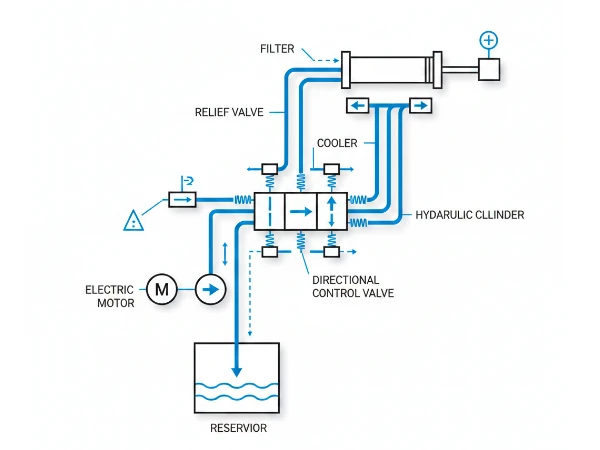
If you maintain or operate hydraulic equipment—whether it's a construction excavator, a manufacturing press, or an agricultural machine—there's one skill that separates quick problem-solvers from the teams stuck waiting on outside technicians: the ability to read a hydraulic system diagram.
A hydraulic system diagram (also called a hydraulic schematic or circuit diagram) is a standardized visual map that shows every component in your hydraulic system and how they connect. It doesn't show physical sizes or spatial positions. Instead, it reveals the functional relationships between hydraulic pumps, motors, control valves, cylinders, and auxiliary components like filters, heat exchangers, and accumulators.
Mastering this skill has direct, practical value. Whether you're designing a new system, diagnosing a pressure drop, or deciding which hydraulic spare parts to order for a repair, your ability to interpret a schematic determines how fast and how accurately you get the job done.
This guide walks you through the complete process—from basic symbol recognition to advanced circuit analysis—and shows how these skills apply to real industrial hydraulic systems across construction, manufacturing, mining, and agriculture.
Table of Contents
Why Hydraulic System Diagrams Matter for Your Operation
Every hydraulic system is built from basic circuits. These circuits represent the fundamental working principles of the system—essentially, they describe what each actuator (cylinder or motor) can do and how it's controlled.
All hydraulic schematics are drawn using standardized graphic symbols defined by ISO 1219. This standardization means that whether your equipment uses Rexroth, Parker, Danfoss, or Eaton components, the schematic language is universal.
Being able to correctly and quickly analyze hydraulic diagrams directly supports:
- Equipment design and system optimization — Understanding circuit logic helps engineers select the right hydraulic pumps and valves for each application.
- Fault diagnosis and troubleshooting — When a machine stalls, overheats, or loses pressure, tracing the oil flow path on a schematic pinpoints the problem component fast.
- Maintenance planning — Knowing which components are in each circuit helps you stock the right replacement parts and schedule preventive maintenance effectively.
- System upgrades and retrofits — Before modifying a system, you need to understand how every circuit interacts to avoid unintended consequences.
The Five Core Components on Every Hydraulic Schematic
Before diving into reading techniques, let's establish the building blocks. Every hydraulic schematic includes these five categories of components, each represented by standardized symbols:
1. Power Source — Hydraulic Pumps
Pumps convert mechanical energy into hydraulic energy. On a schematic, they appear as circles with triangles indicating flow direction. A triangle pointing outward means fluid exits the pump. Fixed-displacement pumps use a simple circle-triangle symbol, while variable-displacement pumps add an arrow through the symbol to indicate adjustable output.
If your system uses axial piston pumps or gear pumps, the schematic will show the pump type and any control mechanisms (pressure compensators, load-sensing controls) that regulate output.
2. Actuators — Cylinders and Motors
Actuators convert hydraulic energy back into mechanical work. Hydraulic cylinders produce linear motion and appear as rectangles (barrel) with a T-shaped symbol (piston and rod). Single-acting cylinders have one port; double-acting cylinders have two.
Hydraulic motors produce rotary motion and are shown as circles with triangles pointing inward (fluid flowing in). Reversible motors display two opposing triangles.
3. Control Elements — Hydraulic Valves
Hydraulic valves are the traffic controllers of the system. They regulate pressure, flow rate, and fluid direction. On a schematic, valves are represented by squares (called envelopes) with internal arrows and symbols showing their switching positions:
Understanding how hydraulic control valves work within a schematic is essential for diagnosing speed, pressure, and directional issues in the field.
4. Transmission Medium — Lines and Connections
Lines on a schematic represent fluid pathways. Recognizing the different line types is essential for distinguishing main working circuits from pilot control and drain circuits:
5. Auxiliary Components — Filters, Coolers, Reservoirs
Filters, heat exchangers, accumulators, and reservoirs keep the system clean and operating within safe temperature and pressure limits:
Step-by-Step: How to Read a Hydraulic System Diagram
Reading a hydraulic schematic is a systematic process. Rushing through it or jumping to individual components without context leads to misunderstandings. Follow these steps for reliable results:
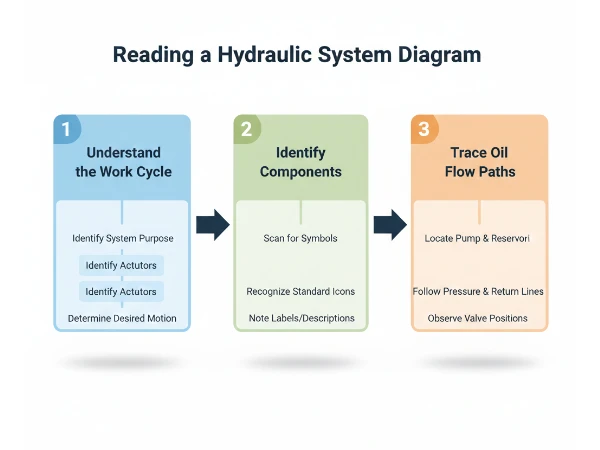
Step 1: Understand the Machine's Function and Work Cycle
Before looking at any symbols, ask: What does this machine do? What movements does it perform, and in what sequence?
For example, a combination machine tool's hydraulic system is primarily a speed-conversion system. Its basic work cycle is: rapid advance → working feed → rapid return. Beyond this basic cycle, you need to pay attention to speed transition smoothness and other performance requirements.
At this stage, review the electromagnetic solenoid action table (if available). This table maps which solenoids are energized during each phase of the work cycle, giving you a roadmap for reading the schematic.
| Work Phase | Solenoid YA1 | Solenoid YA2 | Solenoid YA3 | Motion |
|---|---|---|---|---|
| Rapid Advance | ON | OFF | ON | Slide moves forward at high speed |
| Working Feed | ON | OFF | OFF | Slide advances at controlled low speed |
| Rapid Return | OFF | ON | ON | Slide retracts at high speed |
| Stop / Neutral | OFF | OFF | OFF | Slide stationary, oil returns to tank |
Step 2: Identify Every Component and Its Function
Examine each component symbol on the schematic. Determine its type, operating principle, performance characteristics, and role in the system. For specialized components shown in semi-structural diagrams, take extra care to understand their working principle and any variable mechanisms.
This is where product knowledge becomes invaluable. If the schematic shows a monoblock directional control valve with multiple spools, you need to understand how each spool section controls a different actuator. If it shows a variable-displacement piston pump with a pressure compensator, you need to know how the compensator adjusts flow output.
Step 3: Trace the Oil Flow Path for Each Work Phase
This is the core of schematic reading. For each phase of the machine's work cycle, trace the complete oil path:
Code the oil lines first — Number or color-code each oil line on the schematic. This prevents confusion when circuits share common return lines.
Divide the schematic into reading units by actuator — Each actuator (cylinder or motor) and its associated valves form one reading unit. Read one unit at a time.
For each reading unit, follow this order:
- Identify the work cycle (what movement happens)
- Trace the control circuit (what signals trigger the movement)
- Trace the main oil path (pump → directional valve → actuator → return)

Pay special attention to state transitions — When the system switches from one work phase to another (e.g., from rapid advance to working feed), identify which component sends the switching signal and which control elements respond.
Common Reading Methods
| Method | Best For | Approach |
|---|---|---|
| Drive Chain Method | Simple single-actuator systems | Follow energy flow: pump → valve → actuator → tank |
| Solenoid Table Method | Multi-phase automated systems | Map solenoid states per phase, then trace each oil path |
| Equivalent Circuit Method | Complex multi-actuator systems | Simplify and redraw subsections to isolate logic |
How to Analyze a Hydraulic System Diagram
Reading a schematic tells you what the system does. Analyzing it tells you how well it does it—and where improvements are possible. After you've read and understood the diagram, evaluate it from these four perspectives:
1. Do the Basic Circuits Match the Machine Requirements?
Check whether the selected hydraulic circuits actually achieve the required actuator movements, speeds, forces, and sequences. For example, if a machine requires synchronized movement of two cylinders, the schematic should include a flow divider or other synchronization circuit.
2. Are There Conflicts Between Circuits?
In multi-actuator systems, examine whether the main oil paths interfere with each other. Check whether control circuits create unintended pressure interactions. This is particularly important in systems where multiple actuators operate simultaneously, such as in excavators or multi-station manufacturing equipment.
3. Are Component Selections Appropriate?
Evaluate whether specific components could be substituted, modified, or combined for better performance. For instance, replacing a standard directional control valve with a proportional valve might improve speed control accuracy in applications that demand precision.
4. What Could Be Improved?
Consider system efficiency, heat generation, noise levels, and energy consumption. Modern hydraulic control solutions like load-sensing systems and electro-hydraulic proportional controls can significantly improve performance compared to older fixed-displacement designs.
| Analysis Dimension | Key Questions to Ask | Common Issues Found |
|---|---|---|
| Circuit–Machine Match | Does each circuit achieve the required motion, speed, and force? | Missing synchronization, inadequate speed control range |
| Inter-Circuit Conflicts | Do parallel circuits create pressure interference? | Shared supply causing actuator speed variation under load |
| Component Suitability | Can any component be substituted or combined for better results? | Oversized valves, mismatched pump capacity |
| System Optimization | Where is energy being wasted? What generates excess heat? | Throttling losses, no load-sensing, continuous full-flow pumping |
Real-World Applications: Hydraulic Schematics Across Industries
The ability to read hydraulic schematics applies across virtually every industry that uses fluid power:
Construction Equipment
Excavators, loaders, and cranes use complex multi-circuit hydraulic systems with pilot-operated valves and load-sensing pumps. Reading these schematics helps operators and field technicians diagnose issues like slow boom movement, cylinder drift, or loss of swing function—without pulling the machine apart.
Manufacturing and Metalworking
Hydraulic presses, injection molding machines, and CNC equipment rely on precise pressure and flow control. Schematics for these systems often include proportional or servo valves, accumulators for rapid press cycles, and sophisticated safety interlocking circuits.
Agriculture
Tractors, harvesters, and implement systems use hydraulic circuits for steering, lifting, and powering attachments. Understanding the schematic helps farmers and equipment dealers quickly identify whether a problem is in the tractor's central hydraulic system or in the implement's dedicated circuit.
Mining and Marine
High-pressure systems in mining equipment and marine winches demand robust components and careful system design. Schematic analysis is essential for maintaining these systems in remote locations where downtime is extremely costly.
Connecting Schematics to Parts: Why Component Knowledge Matters
Here's the practical payoff: once you can read a hydraulic schematic, you can identify exactly which component needs replacement or adjustment—without guesswork.
When a schematic shows a directional control valve causing a problem, you need to know which type to source. Is it a monoblock valve or a sectional valve? What spool configuration does it use? What's the rated flow and pressure?
This is where having a reliable hydraulic equipment supplier matters. With over 7,000 spare parts and more than 1,800 specifications of hydraulic pumps, valves, and motors in stock, Pozoom Hydraulic (POOCCA) provides the components that appear on your schematics—from gear pumps and piston pumps to pressure relief valves, directional control valves, and complete hydraulic motor assemblies.
When you understand the schematic, you can communicate your exact needs to a supplier instead of describing symptoms and hoping for the right part. This saves time, reduces incorrect orders, and gets your equipment back in service faster.
Frequently Asked Questions
What are the five core components on a hydraulic schematic?
Every hydraulic schematic includes five categories: hydraulic pumps (power source), actuators such as cylinders and motors, control valves (directional, pressure, and flow), transmission lines and connections, and auxiliary components like filters, coolers, and reservoirs.
What standard governs hydraulic schematic symbols?
Hydraulic schematic symbols are defined by the ISO 1219 standard, which provides a universal language for representing hydraulic circuits across different applications and regions worldwide.
How do I trace oil flow on a hydraulic diagram?
Start by coding each oil line with a number or color. Then divide the schematic into reading units by actuator. For each unit, first identify the work cycle, then trace the control circuit, and finally follow the main oil path: pump → directional valve → actuator → return to tank.
What is the difference between reading and analyzing a hydraulic schematic?
Reading tells you what the system does by tracing component connections and oil flow paths. Analyzing evaluates how well the system performs—checking for circuit conflicts, component suitability, and improvement opportunities.
Key Takeaways
- Hydraulic system diagrams use standardized ISO 1219 symbols to represent functional relationships, not physical layouts.
- Always start by understanding the machine's function and work cycle before reading individual components.
- Trace oil flow paths systematically for each work phase, dividing the schematic into reading units by actuator.
- After reading, analyze the system for circuit conflicts, component appropriateness, and improvement opportunities.
- Schematic literacy directly translates into faster troubleshooting, smarter parts ordering, and better system design.
Whether you're maintaining existing equipment or designing new hydraulic systems, the ability to read and analyze hydraulic schematics is a skill that pays for itself many times over. And when your analysis points to a component that needs replacement, having a trusted hydraulic parts supplier with deep inventory and technical expertise makes all the difference.
Need Help Identifying the Right Hydraulic Components?
From schematic analysis to parts sourcing — our engineers are ready to help. Access over 7,000 hydraulic spare parts across all major brands.
Contact Pozoom Hydraulic

