
The global hydraulic control valve market reached approximately $2.5 billion in 2025 (Archive Market Research, 2024), growing at a 5.5% compound annual rate—and the 2 spool hydraulic control valve sits at the center of that growth. Whether you’re replacing a worn valve on a compact tractor or adding auxiliary hydraulics to a skid steer, getting the right dual-spool directional valve means matching flow, pressure, spool type, and port standard to your specific system. Get any of those wrong, and you’ll deal with sluggish response, excessive heat, or premature wear.
After years of specifying and supplying hydraulic valves across construction, agriculture, and industrial manufacturing, we’ve seen the same selection mistakes cost operators real money and downtime. This guide covers everything from basic operation to sizing, installation pitfalls, and when a 2 spool valve isn’t enough.
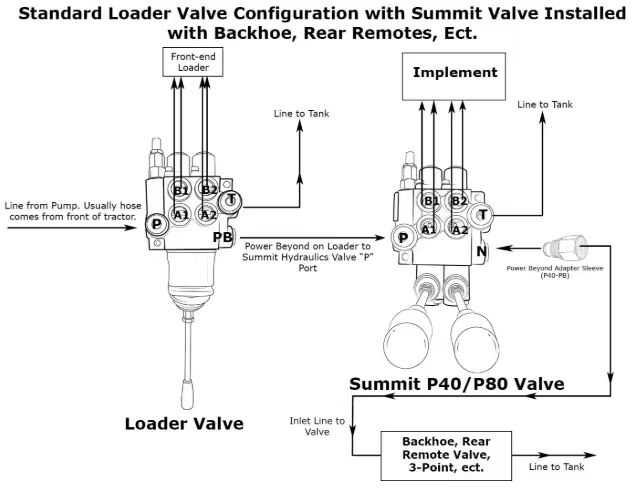
A 2 spool hydraulic control valve is a directional control valve containing two independently operated spools within a single valve body. Each spool manages one hydraulic circuit, directing pressurized fluid to an actuator—a hydraulic cylinder or motor—and routing return fluid back to the tank.
The spool itself is a precision-machined cylindrical element with raised sections called lands and recessed areas called grooves. When the operator shifts a spool via a lever, solenoid, or pilot signal, the lands uncover or block internal ports, redirecting fluid flow. In a typical 4-way, 3-position configuration, each spool offers three states: extend the actuator, retract it, or hold neutral.
On a front-end loader, for example, one spool controls the boom lift (up/down) while the other controls the bucket curl (tilt forward/back). Both operate independently, and the operator can feather both simultaneously for smooth, coordinated movement. Manufacturers like Bosch Rexroth have pushed proportional control in their dual-spool valve lines to achieve precision angle control down to 0.1° levels—though for most mobile equipment operators, standard on/off spool control is more than sufficient.
This is the single most consequential decision you’ll make, and the most common mistake we see.
Open-center valves let fluid flow freely from the pump through the valve and back to the tank when both spools are in neutral. This is standard for gear-pump-driven systems on most tractors and compact equipment. The continuous flow path prevents pressure buildup at idle, protecting fixed-displacement pumps from overheating.
Closed-center valves block all ports in neutral, allowing pressure to build. These pair with variable-displacement (pressure-compensated) pumps that reduce output automatically when demand drops. More energy-efficient at scale—European manufacturers like HAWE Hydraulik push this architecture to meet EU energy directives.
Here’s the critical part: installing a closed-center valve on a fixed-displacement pump system will cause the pump to deadhead against maximum pressure continuously—generating extreme heat and potentially destroying the pump within hours. One customer called us after doing exactly this on a Kubota loader. The pump lasted about 90 minutes before the seals blew. A $55 valve mismatch turned into a $1,200 pump replacement.
Quick rule: Fixed-displacement gear pump → open center. Variable-displacement piston pump → closed center. When in doubt, consult your equipment service manual or contact our technical team for guidance.
Not all spools are interchangeable. Wrong spool type + wrong actuator = unsafe conditions.
“A” Spools (Double-Acting) — The default for double-acting hydraulic cylinders. In neutral, both work ports are blocked, holding the cylinder in position. Covers loader arms, log splitters, and most general cylinder applications.
“D” Spools (Motor) — Designed for hydraulic motors. In neutral, both work ports connect to tank so the motor can freewheel. Never use a D spool on a vertical cylinder—the load will free-fall when you release the lever.
Float Spools — Both work ports and the pressure port connect to tank, letting the implement follow ground contours under its own weight. Essential for loader buckets during grading, snow plows, and dozer blades. For a typical loader setup, you want one float spool (boom) and one A spool (bucket).
Both the P40 Series and P80 Series monoblock valves offer all three spool options, so you can configure the valve precisely for your application.
Use this table to narrow your selection before getting into the details:
| Application | Recommended Spool Config | Flow Range | Center Type | Valve Series |
|---|---|---|---|---|
| Compact tractor loader | 1 Float + 1 A spool | 8–13 GPM | Open center | P40 |
| Log splitter | 2 A spools | 11–16 GPM | Open center | P40 |
| Mid-size loader / backhoe | 1 Float + 1 A spool | 18–25 GPM | Open center | P80 |
| Hydraulic winch / auger | 1 A spool + 1 D spool | 11–21 GPM | Open center | P40 / P80 |
| Industrial press / conveyor | 2 A spools (solenoid) | 21–32 GPM | Closed center | P80 |
Flow Rate (GPM): Your valve’s rated GPM must meet or exceed your pump’s output. Compact tractors under 40 HP typically output 6–12 GPM—a P40-series valve handles this. Mid-size equipment running 15–25 GPM needs a P80-series. Verify your pump’s flow on the equipment data sheet (tractor-data.com lists this under “Hydraulics — Pump Flow”) or read the nameplate on the pump housing. Over-selecting wastes money and energy; under-selecting creates excessive pressure drop and heat.
Pressure Rating (PSI): Standard monoblock valves operate at 2,500–3,600 PSI with burst ratings around 4,600 PSI. Cast iron monoblock construction ensures stable performance under sustained load. Industrial applications above 4,000 PSI continuous may need sectional valve assemblies.
Port Sizes: P40-series valves use #8 SAE O-Ring Boss work ports and #10 SAE inlet/outlet. Some imported valves use BSPP threads—they look similar but have different pitch. Always confirm the thread standard before ordering fittings to avoid a $50 adapter headache.
Count your hydraulic functions—that determines your spool count.
A standard front-end loader uses two functions (boom lift + bucket curl), so a 2 spool valve is the right fit. But if you add a rear remote for a grapple, bale spear, or third-function attachment, you need a 3 spool. Equipment running a loader plus rear remote plus powered thumb requires 4 or more spools.
The practical advantage of monoblock valve families—like the P40 and P80 series available in 1 through 7 spool configurations—is that they share identical mounting patterns and port locations. So if you start with a 2 spool and later need more functions, upgrading to a 3 or 4 spool version in the same series is a direct bolt-on swap. No replumbing, no bracket changes.
Don’t buy more spools than you need, though. Each extra spool adds length, weight, and cost—and more importantly, it adds internal flow restrictions that increase pressure drop, even when those spools sit in neutral.
Tractor applications are the single largest use case for 2 spool monoblock valves, and they come with their own set of considerations.
Most compact and utility tractors run open-center hydraulic systems with gear pumps outputting 6–15 GPM. The valve mounts between the pump output and the loader’s hydraulic cylinders, usually under the hood or behind the seat depending on the tractor design. Key tractor-specific decisions include whether you need a float spool for the boom (you almost certainly do if you grade or plow), whether your existing system has downstream valves that require a power beyond port, and what fittings will mate with your tractor’s existing hydraulic lines.
One detail that trips up first-time buyers: if your tractor already has a factory rear remote valve, you need the power beyond adapter on your new 2 spool valve. Without it, the rear remote gets zero flow when your loader spools are in neutral. This is an open-center-only issue—and it’s the number one support call we get from tractor owners installing aftermarket loader valves.
Manual lever-operated — Simplest and most common for mobile equipment. Operator shifts each spool by hand; spring return centers it. Response time around 0.5–1 second. No electrical connections needed.
Solenoid (electrically) operated — Electromagnetic coils shift the spools in 0.1–0.3 seconds. Required for remote control, automation, and cab-mounted switch panels. Trade-off: heat buildup limits most solenoid valves to 80% duty cycle. Electric actuation is a fast-growing segment, projected at 8.2% CAGR through 2033 as Industry 4.0 adoption accelerates (Archive Market Research).
Pilot-operated — A small hydraulic signal shifts larger main-stage spools. Handles higher flow and pressure than direct solenoid actuation. Standard on large excavators and industrial presses.
Pozoom’s monoblock valves support manual, pneumatic, electric-pneumatic, and hydraulic-electric actuation—configurable to your control requirements.
Wrong center type for your pump — Covered above. Closed-center valve on a gear pump = destroyed pump. We’ve seen it happen more than once.
Spool/actuator mismatch — D spools on vertical cylinders cause uncontrolled load drop. Always: A spools for cylinders, D spools for motors.
Contamination — 70–80% of hydraulic component failures trace back to dirty fluid. Particles at 5 microns—invisible—score spool surfaces and increase internal leakage. Using oil meeting ISO 16/14/11 cleanliness can reduce valve failure rates by up to 70% (Cross Manufacturing technical data). Flush your lines and replace the return filter before installing any new valve.
Over-torqued fittings — SAE O-ring fittings seal on the O-ring, not brute force. Over-tightening cracks cast iron valve bodies. Follow specs: 25–35 ft-lbs for #8 SAE, 35–50 ft-lbs for #10 SAE.
A quality 2 spool hydraulic control valve lasts 8,000 to 12,000 operating hours under normal conditions. In agricultural use with proper maintenance, valves routinely hit 15,000 hours. The key is proactive fluid management—not reactive repair.
Professional maintenance calls for inspections every 500 hours: check seal condition, evaluate spool wear, test for internal leakage. In high-dust environments or continuous-duty agricultural use, shorten that to 300 hours. Spool sticking—the primary failure mode per Cross Manufacturing’s service manuals—is almost always caused by contamination or seal aging, both preventable with good filtration.
Companies like HYDAC now offer intelligent valve bodies with embedded pressure and temperature sensors, transmitting real-time data via industrial IoT for predictive maintenance—cutting unexpected downtime by up to 60%. For most operators, though, the fundamentals matter more: clean oil, proper filters, and regular inspections. If your machine feels sluggish or cycle times are increasing, internal leakage past worn spool edges is the likely culprit. Our guide on diagnosing a failing hydraulic control valve walks through the process step by step.
Pricing varies significantly by quality, flow rating, and actuation type. Entry-level 2 spool monoblock valves from budget importers start around $40–$70. Mid-range cast iron monoblock valves with proper SAE ports—like the P80 2-spool valve—typically run $50–$120. Premium sectional valves from brands like Parker or Cross Manufacturing range from $300 to $800+ depending on configuration.
The cheapest valve isn’t always the cheapest solution. A $45 valve with BSPP ports instead of SAE means $30–$50 in adapter fittings and a weekend of rework. A valve without an available power beyond option may force you to replumb your entire system later. Buying from a supplier with technical support costs slightly more upfront but saves significant time and frustration.
The 2 spool hydraulic control valve remains the workhorse of dual-function hydraulic systems. Match the center configuration to your pump type, select the right spool types for your actuators, size the valve to your system’s GPM and PSI, and verify port standards before ordering fittings. Those four decisions determine whether your valve lasts 15,000 hours or becomes a $1,200 lesson.
Need help matching a valve to your system? Pozoom Hydraulic’s technical team responds within 12 hours, with access to 7,000+ hydraulic components in stock—including the full P40 and P80 monoblock directional control valve range in 1 through 7 spool configurations.
A 2 spool hydraulic control valve independently controls two hydraulic functions from a single valve body. The most common application is a front-end loader, where one spool operates the boom (lift/lower) and the other operates the bucket (curl/dump). Other uses include log splitters with dual cylinders, tractor auxiliary hydraulics, small crane systems, and compact construction equipment.
Yes—a 2 spool valve is the standard choice for tractor loaders. You’ll typically want one float spool for the boom and one double-acting (A) spool for the bucket. Make sure the valve’s GPM rating matches your tractor’s pump output, choose open-center if your tractor uses a gear pump (most do), and add a power beyond adapter if you have downstream valves like a rear remote.
A closed-center valve on a fixed-displacement (gear) pump system forces the pump to deadhead against full pressure at idle, causing rapid overheating and potential pump failure—sometimes within hours. An open-center valve on a variable-displacement pump system wastes energy and prevents the pump from going to standby. Always match center type to pump type.
Match the valve’s GPM rating to your pump’s actual output. Compact tractors under 40 HP typically run 6–12 GPM, so an 11–13 GPM P40-series valve is ideal. Mid-size equipment producing 15–25 GPM needs a 21–32 GPM P80-series valve. Over-selecting wastes money and energy; under-selecting causes excessive pressure drop, heat, and reduced actuator speed.
Standard service life ranges from 8,000 to 12,000 operating hours depending on conditions and maintenance. Well-maintained agricultural valves routinely reach 15,000 hours. The biggest factor is fluid cleanliness—contamination causes 70–80% of all hydraulic valve failures. Regular filter changes and oil analysis extend valve life significantly.
The only difference is the number of independent hydraulic circuits the valve controls. A 2 spool handles two functions (e.g., loader boom + bucket); a 3 spool adds a third (e.g., rear remote for a grapple). Monoblock valve families like the P40 and P80 series share the same body design across spool counts, so upgrading from 2 to 3 spools is a direct bolt-on replacement.


